A study of 5,000 support agents found that AI-assisted agents handled 13.8% more inquiries per hour, while lower-performing agents improved throughput by 35%. This suggests that high average handle time is affected by systems and workflows, not just agent performance.
| TL;DR – 30 Seconds Quick Takeaway The problem: High AHT is usually caused by operational inefficiencies, not just agent performance issues. The Reality: Poor routing, legacy systems, and manual workflows increase talk time, hold time, and after-call work. The insights: Agents using AI-powered contact center tools can handle almost 13.8% more inquiries per hour. The Fix: AI-powered contact center management software helps reduce AHT through intelligent routing, automated responses, unified agent desktops, and omnichannel customer context. |
Every extra minute an agent spends on a call costs your business money and tests the patience of the customer on the other end.
Average Handle Time (AHT) directly impacts contact center performance and determines cost per contact, customer satisfaction scores, and how quickly your agents burn out.
Can a few training sessions fix the problem, or does it require a deeper, system-level fix?
The real issue is inefficient tools, poor routing logic, manual post-call workflows, and disconnected CRMs. Modern contact center management software addresses these issues, helping businesses reduce handle time at scale. Let’s find out in this guide.
What Is Average Handle Time and Why Is It Important for Contact Centers
AHT measures the total time an agent spends on a single customer interaction, from the moment the call or chat connects to the moment they finish post-call work.
The formula:
AHT = Interaction Time + Hold Time + After-Call Work (ACW)
Each component is driven by different operational factors:
- Talk time is impacted by how accurately calls are routed, how quickly agents can find answers, and whether they have the right tools during the conversation.
- Hold time goes up when agents can’t find information fast enough, usually a knowledge base or CRM problem.
- After-call work is where a significant amount of time is consumed. Agents manually logging notes, tagging dispositions, and updating CRM records add minutes to every single interaction.
In omnichannel environments, AHT is getting worse because customers switch among chat, phone, and email, and expect the agent to have complete context. When systems are not synced, agents spend the first two minutes finding out what already happened, increasing talk time before the actual problem is even addressed.
AHT is directly connected to:
- Customer Satisfaction (CSAT)
- Operational cost per contact
- Agent burnout and turnover
How Is AHT Calculated?
The calculation itself is quite simple. You need to add the total talk time, hold time, and after-call work for all interactions, then divide by the number of contacts handled.
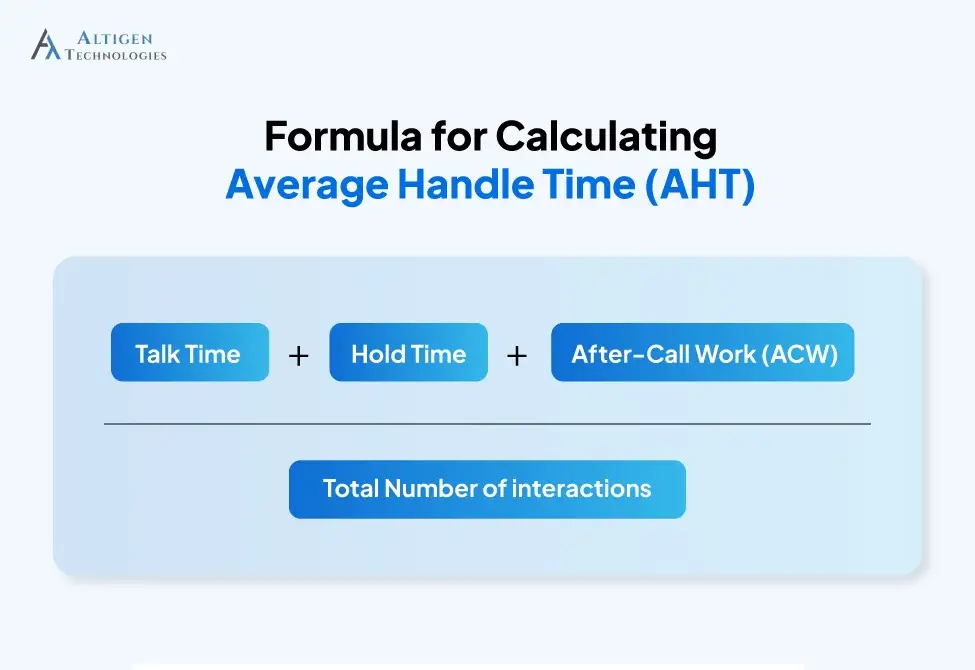
AHT is calculated using a simple formula:
AHT = (Talk Time + Hold Time + After-Call Work) ÷ Total Number of Interactions
Talk Time is influenced by:
- Routing accuracy
- Agent knowledge access
- Real-time assistance tools
Hold Time is determined by:
- CRM speed and responsiveness
- Knowledge base accessibility
- System integration efficiency
After-Call Work (ACW) is determined by:
- Automation of summaries
- AI-generated notes
- CRM auto-population
Reducing AHT requires improving all three layers, not just agent behavior.
What Is a Good AHT? Industry Benchmarks by Sector
One of the most common mistakes in AHT management is chasing a benchmark without understanding whether it applies to your industry. A 2-minute handle time that looks great for a telecom company is too low for a technical support desk. Here is the average handle time benchmark. (Source: Kayako)
| Industry | AHT Benchmark |
| Healthcare | 6.6 minutes |
| Telecommunications | 2-4 minutes |
| Financial Services | 4 minutes 45 seconds |
| Retail and eCommerce | 3-5 minutes |
| Travel and Hospitality | 5–7 minutes |
| SaaS/Technical Support | 7–10 minutes |
The key takeaway: AHT targets need to be set in context. A healthcare contact center pushing agents to wrap up calls in under 3 minutes is nothing but affecting resolution quality to hit a number that doesn’t apply. That creates a more serious problem: repeated contacts.
Why Traditional Ways of Reducing AHT are Ineffective
Traditional approaches to reducing AHT, such as script optimization, additional training, and tighter supervision, can only improve performance to a certain extent. Here’s why it doesn’t work at scale:
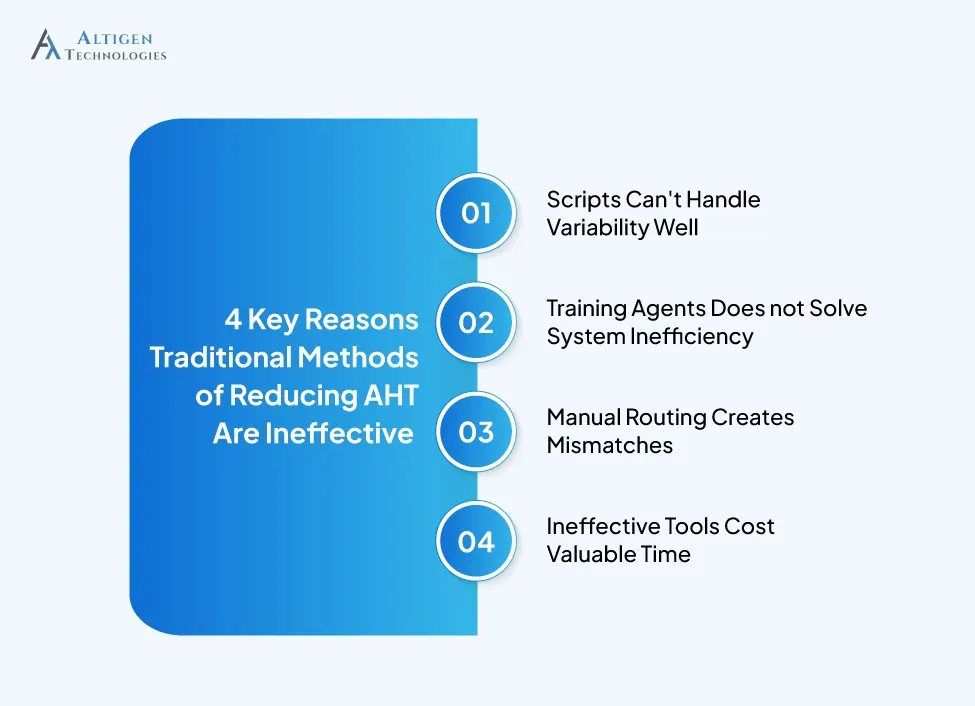
1. Scripts Don’t Handle Variability Well
Customers don’t follow scripts. The moment a conversation goes slightly off-track, agents are improvising, and a rigid script becomes a liability rather than a guide.
2. Training Agents Does not Solve System Inefficiency
Coaching employees to navigate inefficient systems more efficiently may improve performance temporarily, but it does not fix the underlying operational inefficiencies that continue to slow down every interaction.
3. Manual Routing Creates Mismatches
When calls are routed based on simple IVR selections rather than actual customer intent or agent skill, transfers happen. Every transfer can add 2–4 minutes to handle time and increases customer frustration.
4. Ineffective Tools Cost Valuable Time
Agents toggling between five different systems, CRM, ticketing, knowledge base, communication platform, and scheduling, lose 10–30 seconds on every transfer. Those seconds add up to hours across a contact center team.
The core problem is only the performance. In most cases, high AHT is a result of inefficient systems, poor workflows, and outdated contact center infrastructure.
How Contact Center Management Software Reduces Handle Time
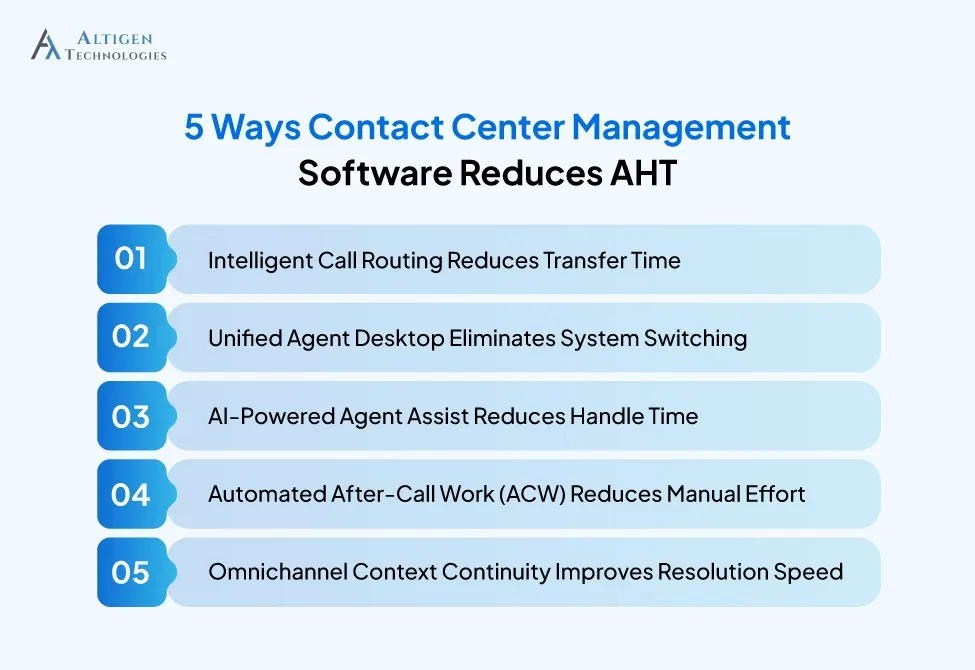
1. Intelligent Call Routing Reduces Transfer Time
Intent-based routing reads what the customer actually wants, and routes the call or chat accordingly. CRM-driven routing factors in customer history, so a high-value account with an open issue doesn’t land in a general queue.
Context-aware routing is the next step: it passes the full customer context to the agent before the call begins. The employee knows who they’re talking to, what they last contacted about, and what’s already been tried.
2. Unified Agent Desktop Eliminates System Switching
A unified desktop provides CRM data, ticketing, communication channels, and knowledge base access into a single interface. Instead of switching between multiple applications during a conversation, employees can manage customer interactions from one workspace. This helps in reducing talk time and hold time.
Here is how a call center agent productivity software help:
- Access customer history without switching tabs
- Find answers faster through integrated knowledge bases
- Reduce delays caused by manual system navigation
- Focus more on resolving issues instead of managing tools
3. AI-Powered Agent Assist Reduces Handle Time
AI-powered tools help reduce talk time, transfers, and escalations. According to McKinsey, organizations using advanced AI in customer assistance operations can reduce operational expenses by up to 40%. The AI capabilities you should look for in call center management system include:
- Intent detection to route customers based on the actual issue
- Real-time knowledge base suggestions and recommended responses
- Implementation of self-service options that automate routine requests or frequently asked questions.
AI is also improving compliance and quality monitoring. For example, Altigen’s partnership with Tollring provides Microsoft Teams compliance recording with AI-driven analytics, helping organizations monitor interactions, identify trends, and ensure compliance.
4. Automated After-Call Work (ACW)
After-call work is one of the most under-optimized parts of the contact center workflow. Usually, employees spend 2-3 minutes per interaction manually logging notes, tagging call outcomes, and updating CRM records.
Modern platforms automate most of this through:
- AI-generated call summaries populate the CRM automatically after the call ends.
- Disposition tagging is suggested based on conversation content.
- Tickets are created and routed with minimal input.
5. Omnichannel Context Continuity
Customers often switch between chat, email, and phone support during a single issue. Without omnichannel capability, agents start every interaction without context. They have to ask customers to repeat information multiple times. This increases talk time and frustrates customers.
Customer support software with interaction history helps executives to:
- View previous conversations across all channels
- Access the complete customer context before the interaction starts
- Reduce repeated explanations and duplicate troubleshooting
- Resolve issues faster by maintaining conversation continuity
That single change can eliminate a significant amount of unnecessary talk time on repeat contacts.
Common Mistakes That Increase Average Handle Time
Even with good software in place, certain operational habits undo the gains:
- Over-reliance on manual routing: When intelligent routing tools are available. The IVR setup that worked five years ago is likely misrouting contacts today.
- Treating CRM integration as optional: An agent disconnected from customer history asks redundant questions. That time comes directly out of your AHT.
- Lack of omnichannel visibility: If your voice team can’t see what happened on chat, you’re guaranteeing repeated explanations and extended talk times.
- Ignoring ACW as an AHT lever: After-call work often gets overlooked because it happens after the customer hangs up. But it’s still part of the AHT calculation, and one of the most automatable parts.
- Undertraining AI systems: AI agent assist tools require ongoing calibration. A knowledge base with outdated articles or an intent model that hasn’t been refined in months will surface wrong answers, which increases talk time rather than reducing it.
Closing Thought
High AHT is caused by inefficient workflows, poor systems, and operational bottlenecks. Training and scripting alone cannot solve these issues.
Modern contact center management software addresses AHT at its root through smarter routing, unified desktops, real-time AI support, automated post-call workflows, and true omnichannel continuity.
Platforms like Altigen’s CoreEngage help businesses reduce AHT through AI-powered agent assistance, intelligent routing, CRM integrations, and unified customer context that improve agent efficiency across every interaction. Explore CoreEngage to see how it can help reduce AHT. Schedule a demo today.
Frequently Asked Questions
You can reduce hold time by integrating your CRM and knowledge base directly into the agent desktop. When agents can find answers without switching systems, it drops hold time significantly.
You can reduce response time by automating repetitive tasks, using AI chatbots, integrating communication tools, and giving agents instant access to customer history and knowledge bases.
The 80/20 rule means answering 80% of customer calls within 20 seconds. It is a common service-level benchmark used to measure contact center responsiveness and staffing efficiency.
Modern contact center software reduces AHT through intelligent call routing, AI-powered agent assist, automated after-call work, unified agent desktops, and omnichannel customer context. These features help agents resolve issues faster with fewer transfers and delays.
A good AHT depends on the industry and complexity of customer issues. For example, telecommunications contact centers may average around 2–3 minutes, while financial and technical support teams may require 6-8 minutes per interaction.
Higher AHT means agents handle fewer interactions per hour, increasing the cost per contact. It also creates longer queues, more abandoned calls, repeated contacts, and higher agent workload.
Altigen CoreEngage helps reduce AHT through AI-powered agent assistance, intelligent routing, CRM integrations, unified customer context, and automated workflows that improve agent efficiency.