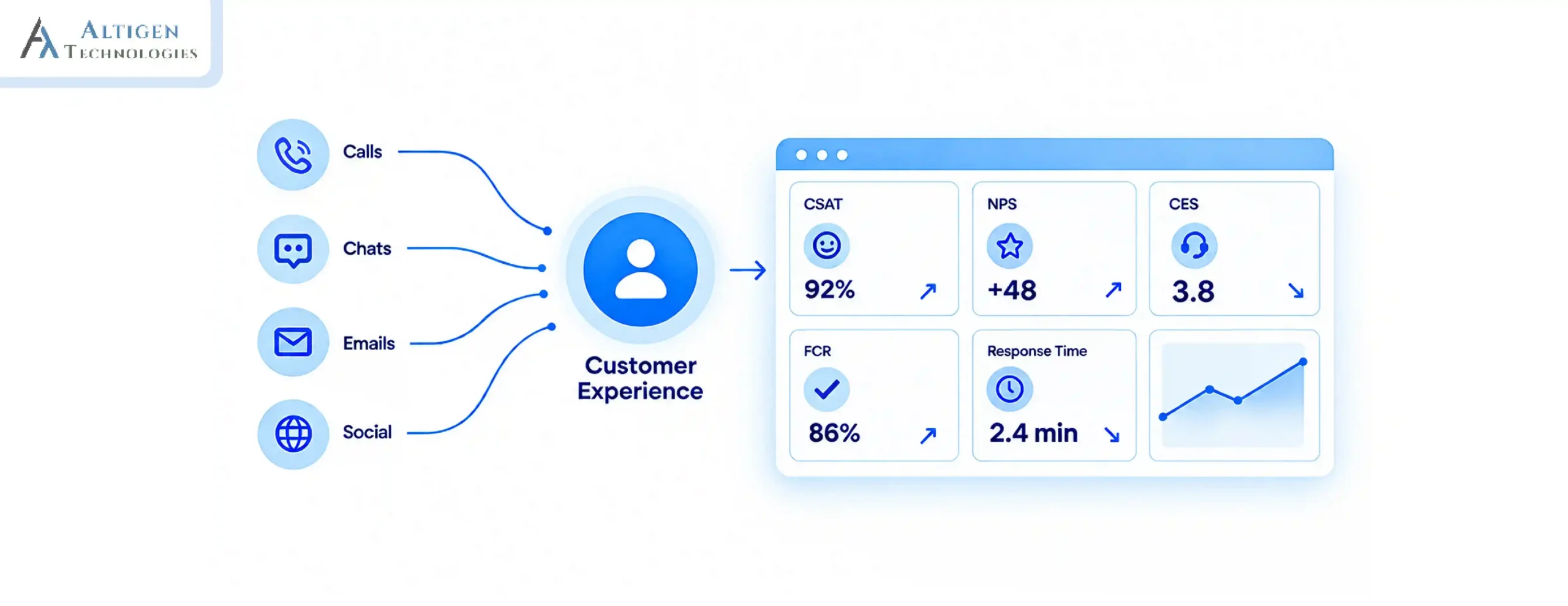
A new contact center platform promises shorter handle times, better agent productivity, more automation, fewer transfers, and stronger customer retention. But most of them do not explain the numbers clearly enough for finance teams to approve the investment. ROI has been the top obstacle to customer experience investment for several years running, and according to CX Network’s research, 66% of CX leaders said the pressure to prove ROI is increasing.
Most vendor pitches stop at “you’ll save money” without showing the math behind it, which leaves finance and operations leaders stuck defending a business case they can’t fully substantiate.
This article provides a complete framework for calculating contact center solution ROI: what to include in your cost calculation, how to convert operational metrics into real dollar figures, and how to build a model that the finance team can understand and approve.
| TL;DR – A Quick Takeaway 1. Contact center software ROI reflects the financial return a platform generates relative to its total investment. 2. A complete ROI calculation includes software, implementation, internal, operating, and transition costs. 3. Operational improvements such as lower AHT, reduced ACW, automation, fewer transfers, lower attrition, and better retention can be translated into financial value. |
What is contact center platform ROI?
Contact center ROI measures the financial return a platform generates. It sounds simple until you try to calculate it, mostly because people use several related terms interchangeably when they actually mean different things:
- ROI: the percentage return relative to total investment over a defined period
- Payback period: how long it takes to recover the initial investment
- Total Cost of Ownership (TCO): the full cost of the platform across its lifecycle, not just the sticker price
- Cost per contact: the average cost of handling a single customer interaction
Finance teams need all four, not just ROI. A platform can show a strong ROI percentage over five years while still failing a payback-period test that matters more for near-term budget approval. Understanding these terms helps businesses prevent confusion later.
What is the ROI formula for a contact center platform?
The core formula for calculating the ROI of a contact center tool is simple:
Contact center software ROI = (Total financial benefits − Total investment cost) ÷ Total investment cost × 100
Here’s a basic example:
- Annual financial benefits = $500,000
- Annual investment cost = $350,000
- Net benefit = $150,000
- ROI = 42.9%
The formula is simple, but the numbers you use should cover the same time period.
For example, if you’re calculating ROI for one year, include the one-time implementation cost in the first-year investment. For later years, that cost may no longer apply.
Clearly define the evaluation period and separate one-time costs from recurring costs so the ROI reflects what you actually invested during that period.
What costs should you include when calculating contact center software ROI?
The costs included in a contact center platform ROI calculation include implementation, internal IT hours, training, integration, and running the old and new systems at the same time.
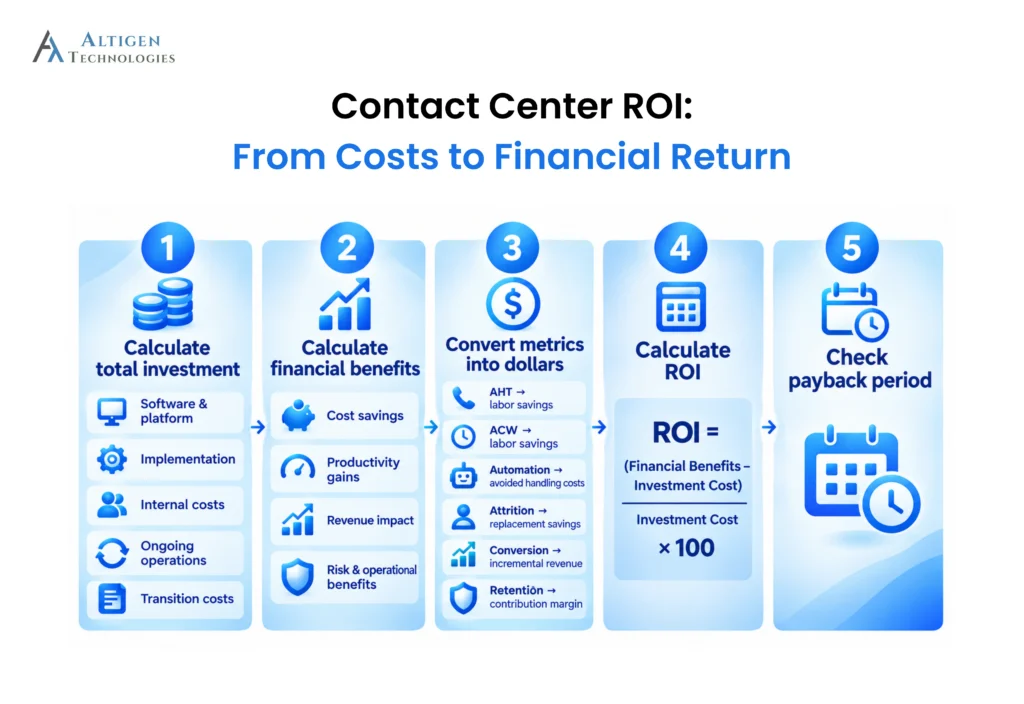
The total investment can be broken into these five categories:
1. Software and platform costs
The software license is one part of the total cost. You also need to consider:
- Per-agent licenses
- Usage or consumption fees
- Telephony
- AI and automation charges
- Additional modules
- Seasonal or temporary licenses
2. Implementation costs
Implementation costs cover the work required to configure the platform and make it usable within your existing environment. This can include platform configuration, professional services, data migration, CRM integration, custom development, and testing.
The amount can vary significantly depending on how much of the implementation your internal team handles and how much support you require from the vendor.
3. Internal costs
Your employees’ time is also part of the investment, even though it does not appear on the vendor invoice. Consider the cost of:
- IT setup and technical support
- Project management
- Agent onboarding and training
- Supervisor training
4. Ongoing operating costs
Once the contact center is up and running, you may still have recurring costs. These can vary based on your setup and may include:
- Support and maintenance
- Telecom and usage charges
- Integration maintenance
- Infrastructure and hosting
5. Transition costs
Moving to a new contact center platform can involve short-term costs during the transition. For example, there are costs associated with:
- Running the old and new platforms in parallel
- Contract termination or cancellation fees
- Replacing outdated hardware
- Productivity losses or downtime during platform migration
To find the Total Cost of Ownership (TCO), you should add the costs that apply to your deployment across these five categories. Use this figure in your ROI model instead of looking only at the license cost.
Suggested Reading: PBX to Cloud Contact Center Migration: A Complete Guide
4 financial benefits you should include in contact center ROI
The financial benefits of a contact center platform fall into four categories: cost savings, higher productivity, increased revenue, and lower risks. Only include a benefit when you can draw a reasonable connection between the operational change and a measurable financial value.
| Cost savings | 1. Lower telecom costs 2. Reduced infrastructure spend 3. Reduced IT support burden 4.Lower cost per interaction |
| Higher productivity | 1. average handle time (AHT) 2. Reduced after-call work (ACW) 3. Higher agent occupancy 4. Fewer transfersBetter routing accuracy |
| Revenue growth | 1. Higher conversion rates 2. More cross-sell and upsell opportunities 3. Lower customer churn 4. Higher customer lifetime value |
| Lower risks | 1. Reduced downtime 2. Lower compliance exposure 3. Better recording and auditability 4. Fewer business disruptions |
Suggested Reading: Is Your Contact Center at Risk?
How to convert contact center metrics into financial value?
Contact center metrics can be converted into financial value by linking each operational metric to a measurable cost or revenue outcome. The calculation should use the metric improvement, annual interaction volume, labor or operating cost, and the relevant financial value.
- AHT savings: Annual labor savings = AHT reduction × annual interaction volume × cost per agent minute.
For example, a 30-second AHT reduction across 500,000 annual interactions at a fully loaded agent cost of $0.50 per minute would produce a measurable saving that can be included in the ROI model. - After-call work (ACW) savings: Annual savings = ACW reduction × annual interactions × cost per agent minute
- Automation savings: Annual savings = automated interactions × cost of a human-handled interaction. AI-driven deflection can have a direct impact on this calculation. A McKinsey report shows that organizations deploying AI alongside human agents have cut cost-per-call by as much as 50%.
- Transfer reduction savings: Calculate the avoided handling time or cost created by routing more calls correctly the first time.
- Attrition savings: Annual savings = avoided departures × average replacement cost per agent. Agent turnover can be a significant cost for contact centers.
A report suggests an average annual agent turnover rate of 58% across surveyed contact centers, with increased workload cited as the top reason. - Revenue from better customer service: Incremental revenue = additional conversions × average revenue per conversion
Which contact center platform metrics are the most important for ROI?
| Metric | What Changes | How to Translate It Into Financial Value |
| AHT | Time per interaction | Labor capacity and cost |
| ACW | Post-interaction work | Labor cost or capacity recovered |
| FCR | Repeat contacts | Avoided interaction costs |
| Transfer rate | Additional handling steps | Avoided transfer and handling cost |
| Automation/containment | Human contacts avoided | Cost per contact avoided |
| Agent attrition | Employee turnover | Recruitment and training savings |
| Conversion rate | Sales outcomes | Incremental revenue |
| Retention | Customers kept | Preserved contribution margin |
| Downtime | Lost operating time | Avoided lost interactions and revenue |
How to calculate contact center software ROI: A worked example
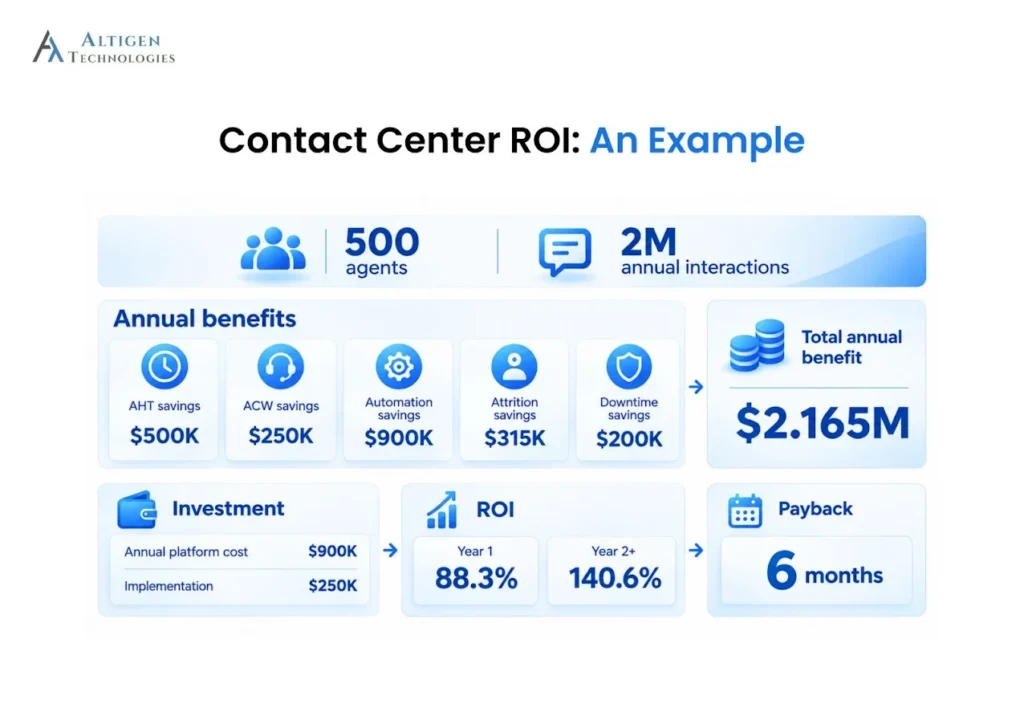
Consider a 500-agent contact center handling 2 million annual interactions.
Current state:
- AHT: 6 minutes
- ACW: 45 seconds
- Fully loaded agent cost: $0.50 per minute
- Annual attrition: 45%
- Average replacement cost per agent: $4,500
- Downtime: 40 hours per year, costing roughly $8,000 per hour in lost revenue and productivity
New platform assumptions:
- AHT falls by 30 seconds
- ACW falls by 15 seconds
- Automation handles 5.5% of total interactions
- Attrition drops from 45% to 38%
- Downtime falls by 25 hours
Calculating the benefits:
- AHT savings: 0.5 minutes × 2,000,000 interactions × $0.50 = $500,000
- ACW savings: 0.25 minutes × 2,000,000 interactions × $0.50 = $250,000
- Automation savings: 110,000 automated interactions × $3.00 average cost avoided = $330,000
- Attrition savings: 35 fewer departures (7% of 500) × $4,500 = $157,500
- Downtime savings: 25 hours × $8,000 = $200,000
- Total annual benefit: $1,437,500
Cost side:
- Annual platform and licensing cost: $900,000
- One-time implementation cost: $250,000 (Year 1 only)
Year 1 ROI:
ROI = ($1,437,500 − $1,150,000) ÷ $1,150,000 × 100 = 25.0%
Year 2 onward ROI (implementation cost no longer applies):
ROI = ($1,437,500 − $900,000) ÷ $900,000 × 100 = 59.7%
Payback period:
Monthly net benefit = ($1,437,500 − $900,000) ÷ 12 = $44,792
Payback period = $250,000 ÷ $44,792 = 5.6 months
One important point you should remember: this payback calculation measures how long it takes to recover the $250,000 implementation cost after accounting for the annual platform cost. If you want “payback period” to mean recovery of the entire Year 1 investment of $1.15 million, the formula should be different.
How to measure contact center solution ROI after implementation
Contact center ROI should be measured against actual results after the platform goes live, not only against the projections used to approve the investment. This requires comparing the original business case with the financial benefits the platform actually delivers.
- Business case ROI: what you projected before implementation
- Realized ROI: what the platform actually produced once it was running
To close the gap between the two, you should:
- Establish your pre-implementation baseline before go-live
- Measure again at 30, 60, and 90 days
- Recalculate at 6 and 12 months
- Compare actual results against your original projections
- Track adoption rates alongside the numbers, since a platform that isn’t fully adopted won’t produce the benefits you modeled
- Update your assumptions as real data comes in, rather than defending the original projection
Post-implementation measurement is often skipped, but it is what allows you to compare the original business case with actual results.
Final takeaway
Calculating contact center platform ROI should start with a clear view of the total investment and the financial benefits the platform is expected to generate. You must include the cost of software, implementation, operating, and transition, then connect improvements in AHT, ACW, automation, transfers, attrition, retention, and revenue to measurable financial outcomes.
If you’re evaluating a contact center platform that delivers better ROI, you can try Altigen’s CoreEngage. This Microsoft Teams based contact center software offers a 30-40% reduction in cost per contact. Contact us to schedule a demo.
Frequently asked questions
ROI = (Total financial benefits − Total investment cost) ÷ Total investment cost × 100. Always state the time period the benefits and costs cover.
The cost includes software and platform fees, implementation costs, internal costs (IT, training, project management), ongoing operating costs, and transition costs like running two systems in parallel.
You need to multiply the AHT reduction (in minutes) by annual interaction volume, then by the fully loaded cost per agent minute to find the financial impact of reducing average handle time (AHT).
ROI measures how much return you generated against the investment. Payback period measures how long it takes to recover the initial investment. Finance teams usually need both measures to evaluate the investment.
You need to multiply retained customers by contribution margin, not full revenue, and only attribute the share of retention you can reasonably link to the platform.
You can measure at 30, 60, and 90 days after implementation, then again at 6 and 12 months, comparing actuals against your original projections.