A missed disclosure or a data security breach on a single customer call can be an agent error or a sign of bigger compliance issues. The challenge for financial contact centers is to know which call is not meeting compliance standards.
Contact centers built for financial institutions help organizations monitor large volumes of interactions, protect sensitive customer data, and give compliance teams better visibility into potential issues. But with hundreds of platforms claiming to meet financial institution requirements, how do you choose one that meets your security and compliance needs?
In this guide, we shortlist the top six contact center platforms for financial services based on proven track record and customer reviews.
| TL;DR – A Quick Takeaway 1. Financial contact center software needs regulatory coverage (PCI DSS, GLBA, FINRA, TCPA), core banking integration, and secure recording and retention that standard platforms may not offer. 2. Compare 6 platforms built for banks, credit unions, and lenders, including Altigen CoreEngage, Genesys Cloud CX, NICE CXone, Talkdesk, Five9, and Zendesk Suite. 3. Ask vendors for compliance in writing (PCI DSS Level 1, SOC 2, GLBA alignment) rather than relying on marketing claims. 4. The right platform depends on your compliance and integration requirements and call volume, not price or feature count. |
What is financial contact center software, and how is it different from standard contact center software
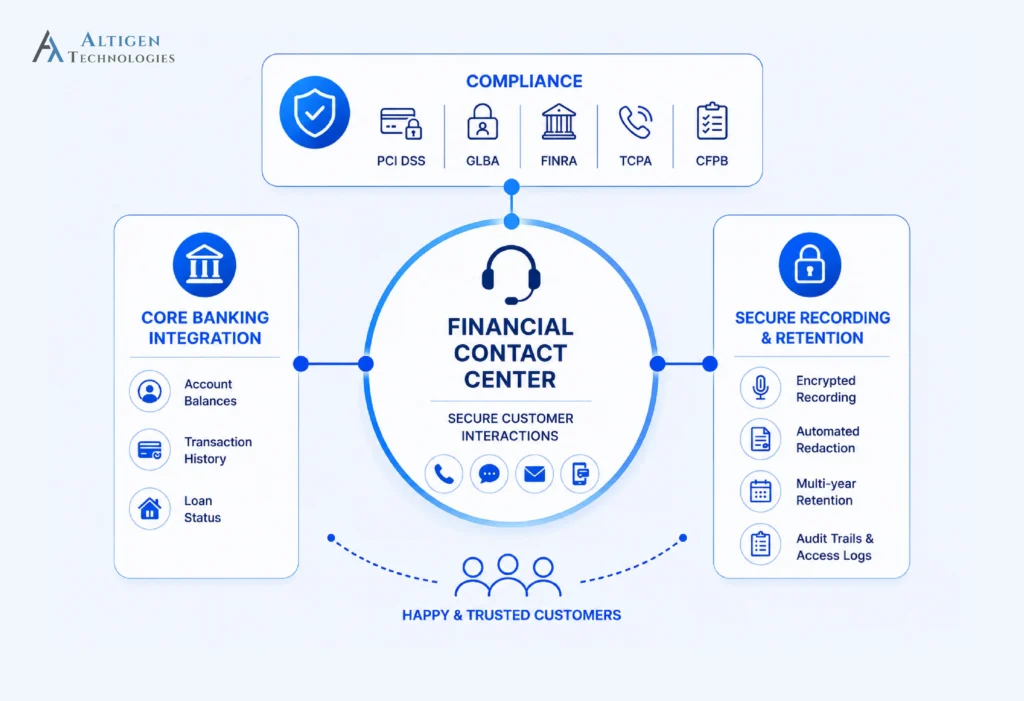
Financial contact center software handles customer interactions across voice, chat, email, and social media, but is specifically designed to meet the regulatory obligations that apply to banks, credit unions, lenders, and insurers.
Three things separate it from general contact center platforms.
1. Regulatory coverage
PCI DSS for card data, GLBA for customer privacy, FINRA for recordkeeping in broker-dealer settings, TCPA for outbound dialing consent, and CFPB expectations for complaint handling and collections conduct.
2. Core banking integration
Agents need account balances, transaction history, and loan status inside the interaction window. Platforms built for this sector ship with connectors to core systems rather than requiring custom development.
3. Secure recording and retention
Encrypted storage, automated redaction of card and account numbers, multi-year retention schedules, and audit trails showing who accessed a recording and when.
Top 6 contact center software for financial institutions
Here is a quick comparison of the top contact center software before we explore them in detail.
| Platform | Best for | Pricing |
| Altigen CoreEngage | Financial institutions using Microsoft 365 | Quote-based custom pricing |
| Genesys Cloud CX | Large multi-region operations | Range from $75 to $240 per user per month |
| NICE CXone | Regulated industries where quality management and compliance | Starts from $110 per user per month |
| Talkdesk | Sector-specific workflows | Starts from $85 per user per month |
| Five9 | Outbound and collections | Starts from $110 per user per month |
| Zendesk Suite | Large teams with high call volume | Starts from $83 per user per month |
1. Altigen CoreEngage
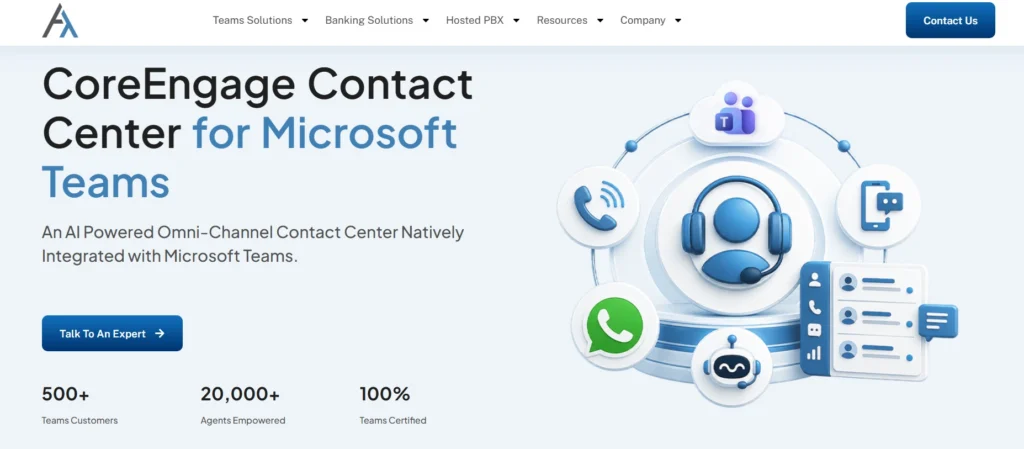
Altigen CoreEngage acts as a native Microsoft 365 application, turning Teams into an omnichannel contact center. Agents, supervisors, and admins work inside the Teams client rather than a separate window.
Best for: Banks and credit unions already running Microsoft 365 that want contact center depth without a second platform to administer.
Key strengths:
- Interaction data stored in your own Azure environment with your encryption keys.
- Complies with ISO 27001, PCI DSS and FINRA
- Altigen is trusted by more than 1,500 banks and credit unions that rely on its platforms.
Potential drawback: It is built on Microsoft-native architecture. Your team needs to work in a Microsoft environment to use it.
Starting pricing: Quote-based, custom pricing based on requirements
Suggested Reading: How to Deploy Omnichannel Contact Center Using Microsoft Teams
2. Genesys Cloud CX
Genesys offers enterprise-grade contact center software for complex, high-volume operations. The platform offers scalable solutions tailored to meet the needs of businesses.
Best for: Large institutions running hundreds of agents across multiple regions and lines of business.
Key strengths:
- Predictive routing and journey orchestration across channels.
- Workforce management is included with higher plans that most competitors sell as an add-on.
- Broad compliance certification coverage including PCI DSS.
Potential drawback: Implementation costs and administrative overhead can be significant, making it expensive for small and medium-sized institutions.
Starting pricing: Prices range from $75 to $240 per user per month.
3. NICE CXone
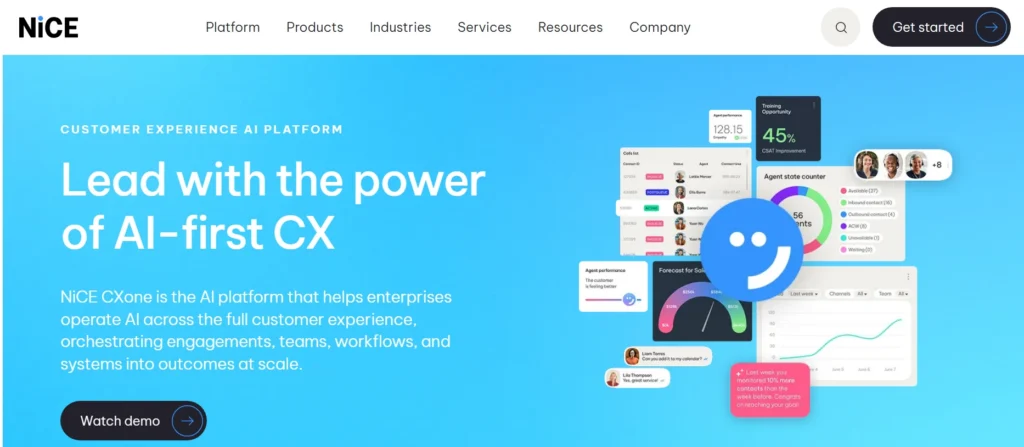
CXone is a cloud-based Contact Center as a Service (CCaaS) provider and customer experience platform. Its AI-powered capabilities can analyze customer interactions at scale, while built-in security, compliance, and data protection features help financial institutions manage sensitive customer conversations.
Best for: Regulated industries requiring advanced quality management and compliance.
Starting pricing: Base price starts from around $110 per agent per month.
Key strengths:
- AI-powered quality management that evaluates more interactions than manual reviews can cover.
- Real-time agent guidance that surfaces required disclosures mid-call
- Interaction analytics built for audit rather than reporting.
Potential drawback: Complex pricing structures and occasional technical issues
4. Talkdesk
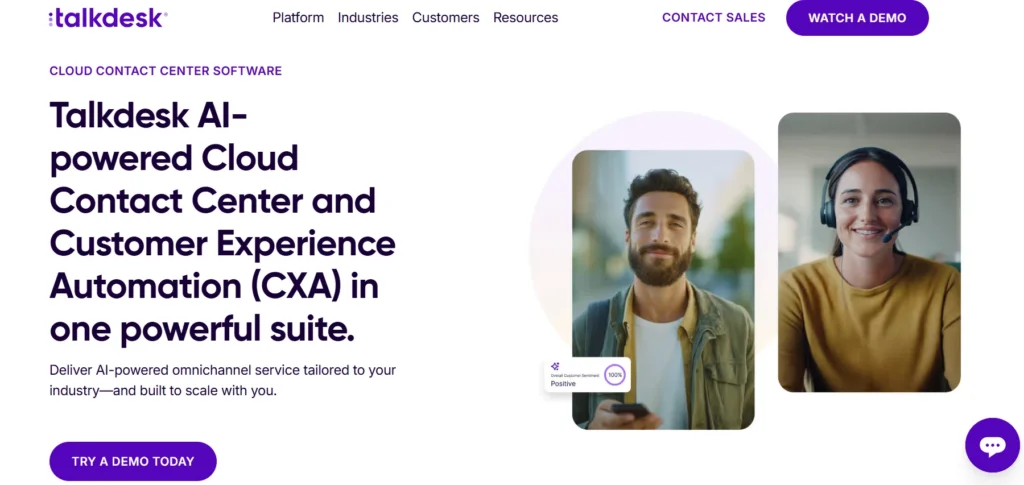
Talkdesk CX Cloud offers contact center software to enterprises, including financial institutions. It provides solutions for customer self-service, omnichannel customer service, employee collaboration, and customer experience analytics.
Best for: Financial institutions that need integrated, custom-built banking workflows.
Key strengths:
- More than 30 security certifications including PCI DSS and ISO 27001
- Pre-built core banking integrations that can shorten deployment time
- Voice biometrics for caller authentication
Potential drawback: Higher costs and lag during peak call volumes.
Starting pricing: Around $85 per user per month at entry tiers.
5. Five9
Five9 supports secure customer interactions, self-service, and compliance requirements, helping banks, lenders, insurers, and other financial institutions manage customer journeys more effectively. The platform is also suitable for outbound contact centers for collections, fraud alerts, and payment reminders.
Best for: Institutions running significant outbound volume alongside inbound service.
Key strengths:
- A published 99.999% targeted uptime SLA for voice, email, and chat, with service credits attached
- Predictive and power dialing with TCPA-aware campaign controls
- Mature CRM connectors
Potential drawback: Users complain about the user interface, reliability, and administrative complexity.
Starting pricing: Entry tiers from roughly $119 per user per month, with a 50-seat minimum.
6. Zendesk Suite
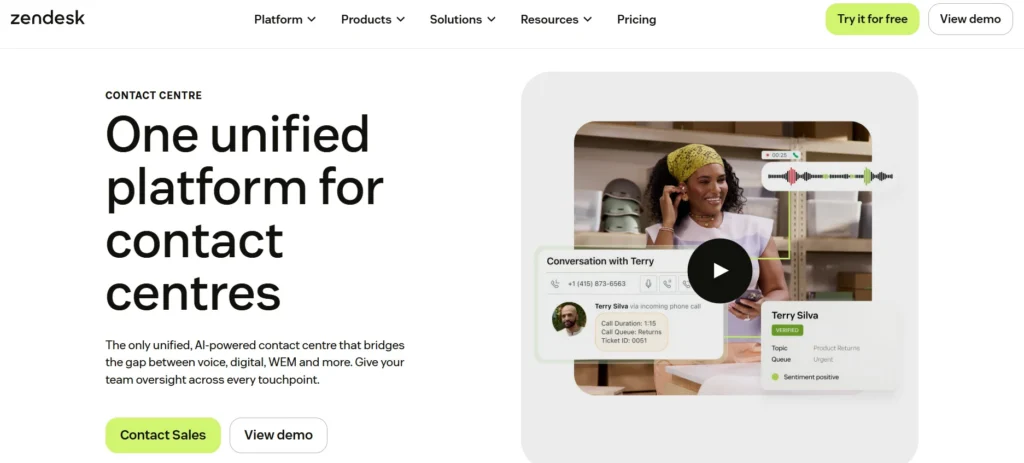
Zendesk contact center software provides voice, digital channels, AI, and workforce engagement into a unified agent workspace. From AI agents and real-time voice copilots to interaction monitoring, quality assurance, and data residency controls, the platform provides capabilities needed for high-volume financial contact centers.
Best for: Larger teams and high-volume environments that require a scalable, AI-powered, unified omnichannel customer experience platform.
Key strengths:
- Strong ticketing and case management capabilities
- Broad integration marketplace
- Faster to deploy than most competitor enterprise CCaaS platforms
Potential drawback: High cost at upper tiers and prices climb quickly as team sizes or support channels grow larger.
Starting pricing: Contact center solutions start from roughly $83 per agent per month
What should you look for when selecting financial contact center software
When selecting a contact center software for a financial institution, you need to consider key features like compliance, data security, integrations, and AI-powered call monitoring.
1. Compliance and security coverage
A data breach can cost your business financially, create legal consequences, and damage your brand image. A recent report found that 56% of CX leaders reported experiencing a data breach or cyberattack targeting customer data in the previous year.
You should verify the security requirements that apply to your institution, including PCI DSS, GLBA, FINRA, and TCPA. Ask vendors for current certifications and documentation rather than relying on marketing claims.
2. Core banking and CRM integration
Check whether the platform integrates directly with your core banking, CRM, loan servicing, and other critical systems. Give preference to vendor-supported integrations over third-party middleware where possible.
3. Recording, retention, and redaction
Financial institutions need to retain customer interactions for regulatory and audit purposes. Look for automated redaction of sensitive data, configurable retention policies, encrypted recordings, and audit trails showing who accessed customer interactions.
4. AI-powered quality and compliance monitoring
As interaction volumes grow, manually reviewing a small sample of calls is not enough to identify every compliance risk. Ask whether the platform can analyze interactions at scale rather than relying on small manual samples.
Additionally, look for software with automated compliance monitoring, real-time alerts, summaries, and agent assistance.
5. Reliability and scalability
A contact center outage can disrupt customer service and critical financial transactions. Moreover, growing interaction volumes can increase costs. That’s why you should evaluate the uptime SLA, available support, how pricing changes as agent and interaction volumes grow, and the cost of required add-ons such as recording, workforce management, and integrations.
Suggested Reading: How to Choose the Right Contact Center Software for Financial Institutions
Questions you should ask when evaluating contact center software for banks
Every vendor presents a demo in a way that shows the tool is perfect for your contact center. Asking the same questions to every provider helps you compare platforms across key areas, including data security, compliance, integrations, reliability, and cost.
- How does the platform protect sensitive customer data, and where is it stored?
- Which compliance certifications do you hold, and can you provide current documentation?
- How does recording, retention, and redaction work, and what does the audit trail capture?
- Can you integrate with our core banking system and CRM, and do you support that integration directly?
- How are complex interactions routed and escalated?
- Which AI features are included, and how is AI governance handled?
- What is your uptime SLA, and what happens during an outage?
- How does pricing change as interaction volume or agent count grows?
Final takeaway
Every financial institution has different requirements, and there is no single best platform. The most important thing is to select a platform that meets your business requirements and fits within your budget. However, don’t focus only on the costs.
Make a list of your requirements like interaction volume, compliance coverage, data security, banking and CRM integrations, recording and retention, AI-powered monitoring, or scalability rather than a feature list.
Then shortlist tools based on that. For institutions already using Microsoft 365, Altigen CoreEngage allows agents to work inside Teams and provide omnichannel routing, compliance recording, and AI-powered monitoring. Contact us to see how Altigen can help you build a more secure, compliant, and connected financial contact center.
Frequently asked questions
Financial contact center software meets the regulatory obligations that apply to banks, credit unions, lenders, and insurers. It adds compliance recording, retention, redaction, and core banking integration to standard contact center capabilities.
You should look for the following key features:
a. Strong data security
b. Compliance recording
c. Role-based access controls
d. Multi-year retention with audit trails
e. Core banking integration
f. AI quality monitoring across all interaction channels
g. Compliance certifications including PCI DSS and SOC 2
Standard platforms optimize for routing and agent productivity. Financial platforms add regulatory frameworks, secure recording and retention, redaction of card and account data, core banking connectors, and audit trails built for examination rather than reporting.
Yes. Financial institutions can use AI in their contact centers to improve customer service, agent productivity, and compliance. AI can support conversational IVR, intelligent call routing, agent assistance, speech and sentiment analysis, automated quality monitoring, fraud detection, and interaction summarization.
A financial contact center should support core banking systems, your CRM, loan origination and servicing platforms, fraud detection tools, and payment processors. You should confirm each integration is vendor-built and vendor-supported rather than running through third-party middleware.
The per-user pricing is usually $75 to $240 per agent per month depending on tier and AI features. Compliance recording, workforce management, and core banking connectors are often priced separately. Ask for a 12-month total rather than a seat rate.
Platforms with pre-built core banking connectors deploy in weeks. Custom integration work extends that to months. Ask each vendor for a reference customer of similar size and charter type, then ask that customer directly.