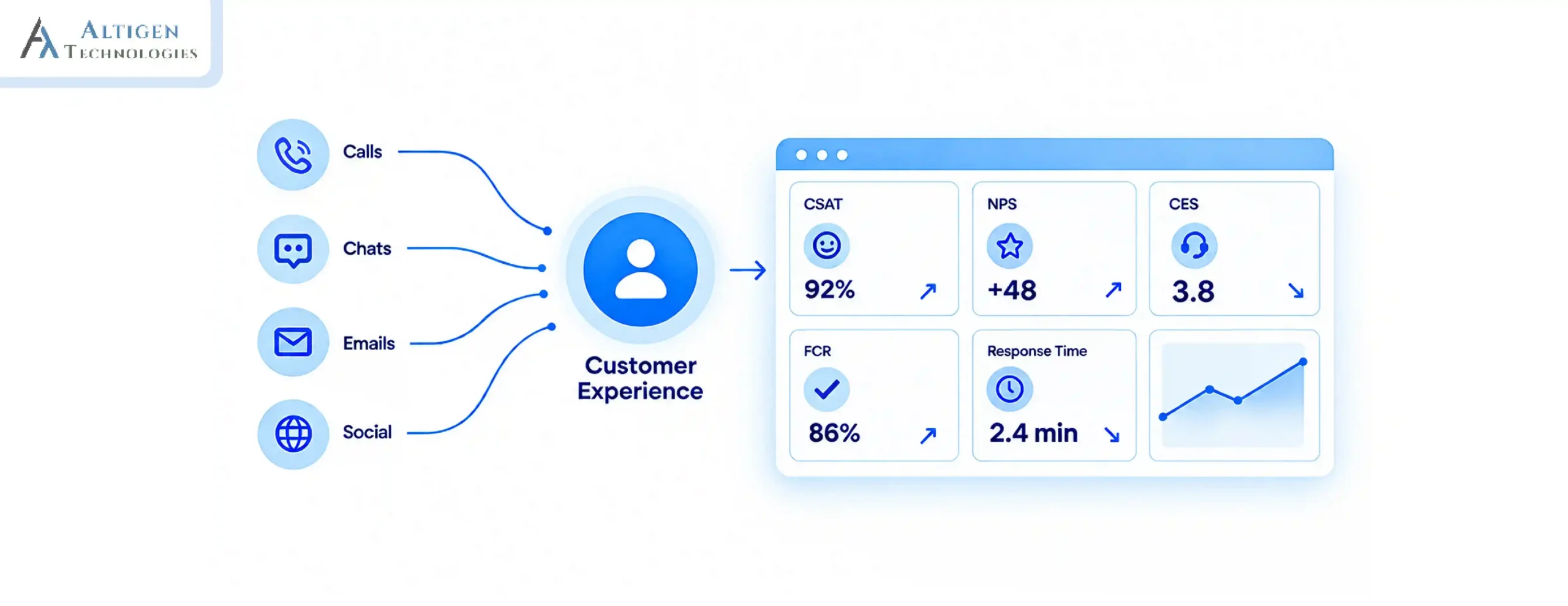
A customer calls your bank, explains the issue, gets transferred, and repeats the same details again. One poor customer service experience can damage customer loyalty, and they may start looking for other options.
| TL;DR — The 30 Second Summary The Problem: Financial institutions are losing customers to poor service experiences and outdated contact center systems. The Insight: Banking contact center software covers more than handling calls. It covers compliance, security, omnichannel experience, and CRM integration. The Fix: Evaluate software across six criteria specific to financial services before committing. Keep reading to: Learn the key factors to evaluate before selecting banking contact center software. |
Customer expectations in banking have changed significantly over the past few years. They want better customer service, yet only 13% of consumers believe their financial institution meets their omnichannel expectations.
This is one of the main reasons why customers become dissatisfied. Customers who experience disconnected service, repeated authentication, or agents without context don’t raise complaints. They quietly move to a competitor.
That’s why selecting the right banking contact center software is critical for every financial institution. This guide helps IT managers and decision-makers understand the key factors to look for in enterprise contact center software for financial institutions.
Why Banking Contact Center Software Is Different from Standard CCaaS
Standard CCaaS platforms are built for general business use, which may not be suitable for regulated industries like finance. Using these solutions creates critical issues like data security that financial institutions cannot ignore. Here is the key difference between standard SaaS and enterprise contact center software for financial institutions.
| Aspect | Standard CCaaS | Banking Contact Center Software |
| Compliance | General data protection | MiFID II, Dodd-Frank, PCI DSS, FINRA, HIPAA |
| Call Recording | Optional add-on | Built-in, encrypted, audit-ready |
| Core Banking Integration | Limited or custom | Pre-built connectors |
| Fraud Detection | Not included | AI-powered, real-time |
| Data Sovereignty | Vendor-controlled | Institution-controlled |
Financial institutions moving away from legacy phone systems also need to understand how modern cloud contact center platforms differ from traditional PBX phone systems. Understanding the difference between modern contact center solutions vs traditional PBX helps you evaluate flexibility and long-term operational costs more effectively.
This comparison of Contact Center Solutions vs Traditional PBX explains the operational and scalability differences in more detail.
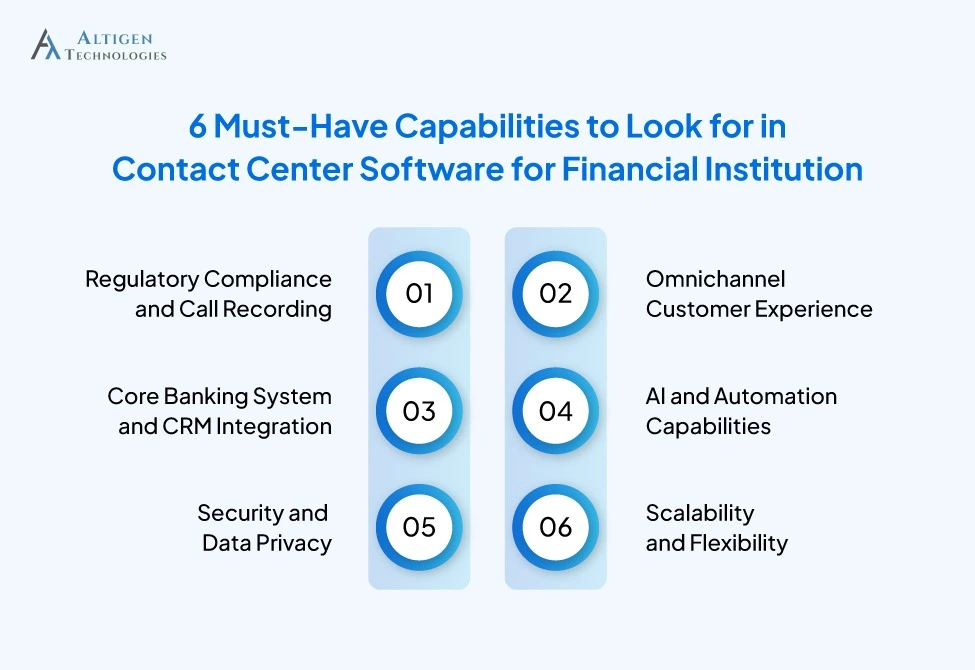
6 Key Factors to Consider When Selecting Contact Center Software for Financial Institutions
Selecting the right enterprise contact center software for a financial institution is critical to improving customer experience, maintaining regulatory compliance, and protecting sensitive financial data. Here are the key factors to consider before choosing.
1. Regulatory Compliance and Call Recording
Institutions in the U.S. and Canada spend approximately $61 billion annually on financial-crime compliance. A significant portion of that cost comes from manual compliance monitoring and reactive responses to audit requests. When selecting an enterprise call center software for a financial institution, ask vendors for actual certification documentation rather than accepting verbal assurances.
Here is what you should look for:
- Automated call recording across all channels with tamper-proof, encrypted storage
- Structured retention policies aligned to PCI DSS, and HIPAA timelines
- Role-based access controls that restrict who can retrieve, review, or export recorded interactions
2. Omnichannel Customer Experience
Poor channel experience is one of the biggest reasons customers switch banks, often more than any other service failure. Customers expect the flexibility to choose voice, chat, email, SMS, and mobile banking while receiving a consistent experience across every channel. Here are the benefits of omnichannel customer experience.
- Unified agent view across all channels
- Consistent customer experience across voice, chat, email, and SMS
- Full conversation history without repetition
3. Core Banking System and CRM Integration
Incomplete data is one of the most common causes of long handle times and inconsistent service across banking contact centers.
A banking contact center with a pre-built connector that syncs data in real time is more important than five integrations that pull cached or incomplete records. When evaluating integration capabilities, focus on:
- Pre-built connectors with Salesforce, Microsoft Dynamics, ServiceNow, and major banking platforms
- Real-time data sync that displays current account information at the start of every interaction
- A single agent view that combines CRM data, interaction history, and account context without switching screens
Financial institutions with complex infrastructure may require technology consulting to ensure smooth integration with core banking systems, CRM platforms, and communication channels.
4. AI and Automation Capabilities
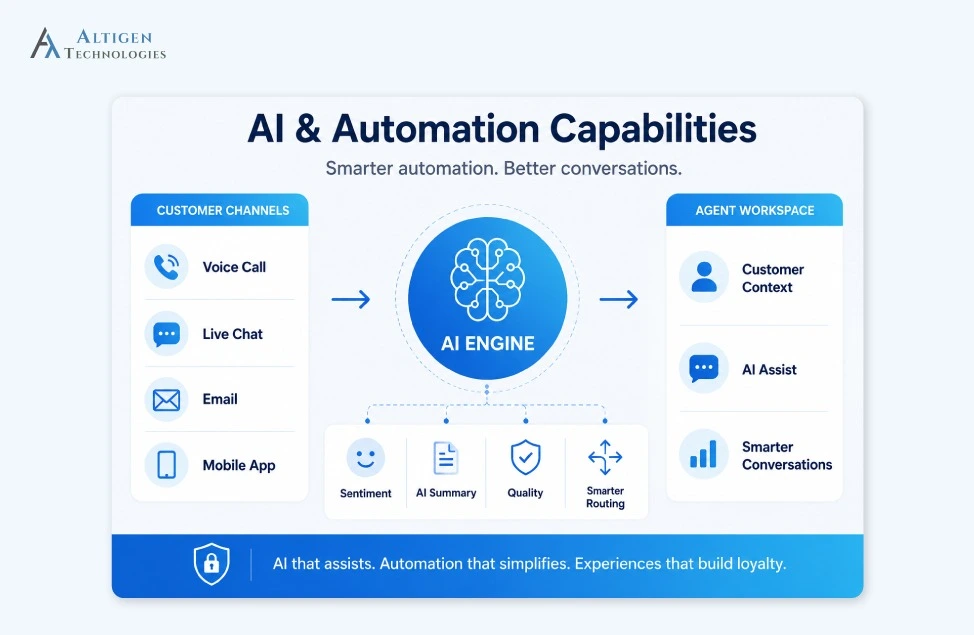
Application of AI in banking contact centers goes beyond basic chatbots and scripted IVR menus. Modern conversational AI can understand customer intent, automate routine requests, assist agents during live conversations, and transfer customers with full context when escalation is needed. Ensure your enterprise contact center software offers the key capabilities, including:
- Real-time sentiment analysis for at-risk interactions
- AI-generated call summaries to reduce after-call work
- Automated quality monitoring across all interactions
- Intelligent routing based on customer intent and agent expertise
- AI-powered insights to identify customer trends and recurring service issues
5. Security and Data Privacy
Financial institutions handle highly sensitive customer data. So, you should evaluate the security details, access control, and data ownership before choosing any enterprise contact center software. Besides, you need clarity on where data is stored, who can access it, and how it is protected. The key security features to look for in a secure contact center platform include:
- SOC 2 Type II and ISO 27001 certifications
- Data residency and ownership controls
- Regular penetration testing and access governance
- End-to-end encryption across all channels and integrations
6. Scalability and Flexibility
Branch expansions, seasonal volume spikes, and distributed remote agents require a platform that can be scaled without hardware procurement delays or infrastructure investment.
Cloud-based enterprise contact center software for financial institutions like CoreEngage for Microsoft Teams Phone offers scalable solutions that allow financial institutions to increase or decrease the capacity based on the requirements. The key benefits of cloud-based solutions include:
- 99.99% uptime with SLA guarantees
- Multi-location support for remote teams
- Flexible agent scaling based on demand
- Regional data residency for compliance needs
Quick Checklist Before Selecting Banking Contact Center Software
Before selecting a financial services contact center platform, use this checklist to evaluate security, compliance, integrations, scalability, and operational fit.
- Compliance support for PCI DSS, MiFID II, Dodd-Frank, FINRA, and related financial regulations
- Native call recording with encrypted, audit-ready storage
- Real-time integration with core banking systems and CRM platforms
- AI capabilities currently available in production, not just on the roadmap
- SOC 2 Type II, ISO 27001, and other security certifications
- Disaster recovery and business continuity measures
- Multi-location and remote agent support without infrastructure dependency
- Implementation timelines, onboarding process, and migration support
Final Takeaway
Selecting the right contact center software for your financial institution reduces data security risks, regulatory exposure and gives agents complete context and assistance during interactions.
A contact center solution like Altigen’s MaxCloud offers omnichannel capabilities, AI-driven assistance, and strong security to improve both customer experience and operational efficiency.
Book a Demo to see how Altigen’s banking contact center solutions meet your institution’s specific requirements.
Frequently Asked Questions
A banking contact center platform is built specifically for financial institutions to manage customer interactions across voice, email, chat, and SMS, with built-in compliance controls, fraud prevention, and core banking integrations that general contact center platforms don’t include.
Banks and other financial institutions operate under strict regulatory requirements, handle sensitive customer data and face growing fraud risk on inbound customer interactions. A general-purpose CCaaS platform requires significant customization to meet those demands yet it may not address compliance gaps.
Yes, provided the vendor holds SOC 2 Type II, ISO 27001, PCI DSS, and relevant regional compliance certifications. Always verify where customer data is stored and what access controls your institution retains.
The pricing varies significantly by platform, seat count, and feature list. Cloud-based platforms usually operate on a per-seat subscription model. Always calculate the total cost of ownership, including implementation fees and integration costs, before comparing vendors.
You should look for platforms that cover PCI DSS and GDPR with automated call recording, structured retention policies, and tamper-proof audit trails.