The cheapest hosted PBX provider may save you some money on your monthly bill, but a single outage can cost far more due to missed calls and disrupted operations.
Metrigy’s 2025 PBX research found that platform reliability is the most important factor businesses consider when choosing a PBX provider, followed by security and technical features.
Price is an important factor, but it should not be the deciding factor when you compare providers. Call quality, uptime, integrations, security, number porting, scalability, support, and the overall cost of the service can affect whether the provider is the right choice for your business.
In this guide, we explain how to select a hosted PBX provider, including the questions to ask, overall costs, and red flags to identify before signing a contract.
| TL;DR – A Quick Takeaway 1. Your hosted PBX provider should give you the reliability, call quality, integrations, security, and support your business needs. 2. The advertised per-user rate may not include setup, hardware, regulatory fees, usage overages, international calling, or premium hosted PBX features. 3. Uptime differences that look small on paper can translate into hours of additional downtime. 4. Test the platform with real users and your actual workflows, including call routing, integrations, administration, mobile access, and number porting. |
7 Key factors to consider when choosing a hosted PBX provider
Before choosing a hosted PBX provider, evaluate the areas that can affect daily operations, reliability, and long-term usability. Here are the top seven factors.
1. Call features and routing
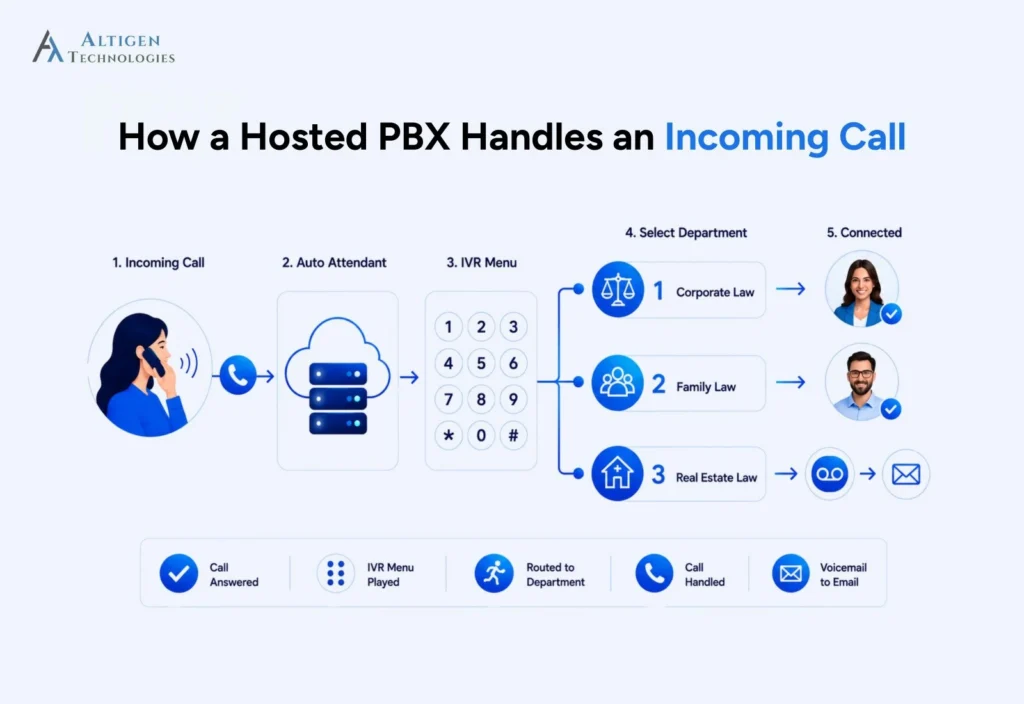
Call handling and routing are the first things you should consider. These features determine how the hosted PBX solution handles incoming calls, directs them to the right person, and handles the call when the intended person is unavailable. Check whether the provider offers features like:
- Auto-attendants: Direct callers to the right department.
- Call forwarding: Route calls to users or devices.
- Voicemail: Capture calls when no one is available.
- IVR: Let callers choose from menu options.
Also, check what is included in your plan, how much control you have over call flows, and whether advanced routing or customization comes with the plan or costs extra.
For instance, a company with separate sales, support, and billing teams may need a multi-level IVR to route callers to the right team without a receptionist to transfer every call.
2. Integrations
Your hosted PBX should connect with the business applications your team already uses. So, check whether the provider offers integrations with your CRM, Microsoft Teams, help desk, or other core tools.
The type of integration determines how much control and support you have. Provider-supported integrations have a clear owner for maintenance and troubleshooting. But third-party connectors can add costs and create support issues when there is service disruption.
3. Reliability and uptime SLA
Reliability is another critical factor to check when selecting a hosted PBX solution because disruptions can interrupt customer calls, internal communication, and day-to-day business operations.
Providers may make claims such as enterprise-grade reliability, always-on communication, but without a specific SLA percentage, these claims sound vague. Ask for a number, like 99.5%, 99.9% or 99.99%. A small difference in the SLA percentage over a one-year period (8,760 hours) can create a massive difference in uptime. For example,
- 99.5% SLA means roughly 44 hours of downtime
- 99.9% SLA means about 8.8 hours of downtime
- 99.99% means about 53 minutes of downtime
The gap between 99.5% and 99.9% looks small but it is more than a full working week of phones being down.
For example, Altigen MaxCloud offers a 99.99% platform uptime commitment, which means only about 53 minutes of potential downtime per year.
Read Case Study: How Forth Foods Improved Communication with MaxCloud UC
4. Security and compliance
Data security can cost your business significantly, making it important to choose a hosted PBX service provider with strong security and compliance measures. This is critical if the system handles sensitive customer or business data.
IBM’s 2026 Cost of a Data Breach Report found that the average cost of a data breach in India reached INR 255 million in 2026, showing the potential financial impact of a security incident.
Before choosing a provider, check these security requirements:
- Encryption: Is call traffic encrypted in transit and at rest?
- Data residency: Which country holds your call recordings?
- Recording compliance: Does the platform support the consent requirements in the states where you operate?
- Certifications: SOC 2, HIPAA, or PCI DSS if your sector needs them.
5. Number porting and setup
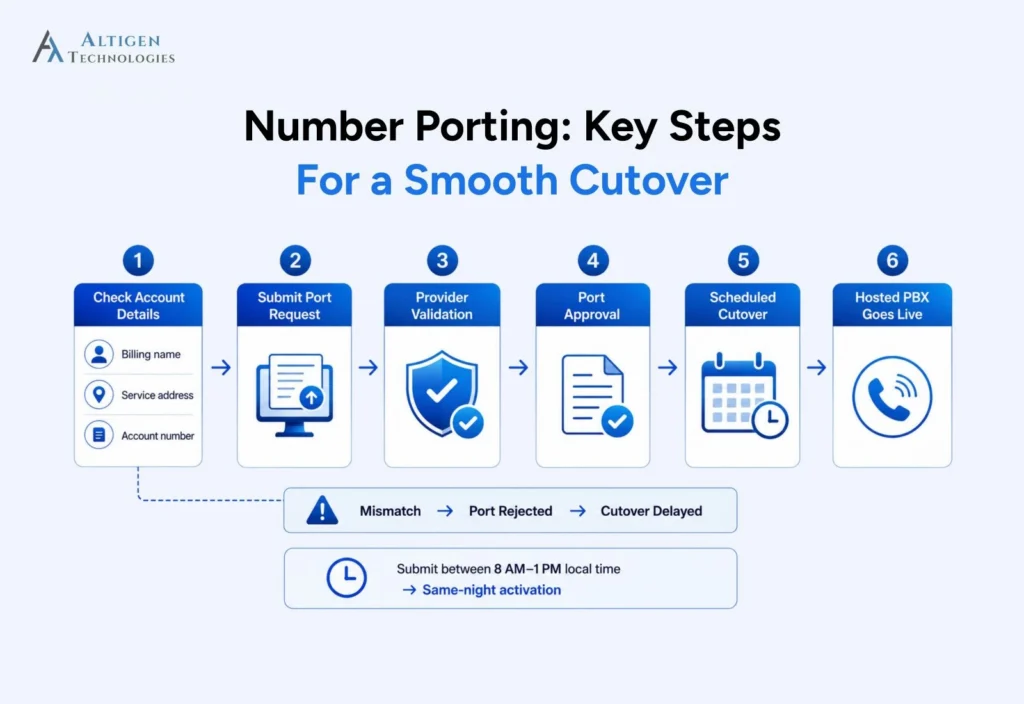
Number porting can affect how smoothly you move from your existing phone system to a hosted PBX system. Delays or errors during the porting process can cause business disruption and customer complaints.
FCC rules set the timelines. Simple ports must be processed within one business day under FCC rules, while complex ports can take up to four business days. Ask every provider three things: who submits the port request, what happens if it is rejected, and can we schedule the cutover for a specific evening?
6. Easy scalability
Most hosted PBX providers offer scalability but you need to check how easily you can add or remove users and whether changes can be made through the admin portal. Moreover, check how the pricing changes if you add or remove users.
For example, your business needs to add 100 temporary employees during its peak season but needs only 20 of those extensions afterward. If the provider lets you add seats but requires a minimum commitment or changes the contract to remove them, your business could end up paying for unused capacity.
7. Support quality
Evaluate the support quality before you sign the agreement. Compare the support channels and check how quickly the provider responds and how issues are escalated. Some providers offer 24/7 support only on higher-tier plans. So, check these support terms before you commit:
- Support hours: Is 24/7 coverage included or an add-on?
- Escalation: Can critical issues reach a technical team?
- Resolution SLA: Does the provider commit to resolving critical issues within a defined timeframe?
- Onboarding: Do you get a dedicated contact during setup?
- Support channels: Can you reach support by phone, email, chat, or through a ticketing system?
How to narrow down your hosted PBX shortlist
When shortlisting hosted PBX providers, you need to find the one that fits your requirements. Here is a step-by-step process.
1. Define your requirements: List the call features, integrations, security requirements, number of users, locations, and support coverage your business needs.
2. Eliminate providers that miss a critical requirement: Remove any provider that does not meet any non-negotiable requirement, like security, SLA, or support quality, even if its price is lower.
3. Request a complete quote: Ask each provider for the total 12-month cost, including licenses, setup, usage, regulatory fees, hardware, and optional features you may need.
4. Test the platform with real users: Use a trial to test call quality, routing, integrations, mobile apps, administration, and the features your employees will use every day.
5. Read the contract: Check the uptime commitment, service credits, cancellation terms, renewal conditions, and support commitments.
6. Choose the provider that fits best overall: Don’t go for the lowest price and largest feature list, but select the one that meets your current and future business requirements.
Suggested Reading: How to Select a Business Communication Platform for Hybrid Workforce
Hosted PBX pricing: what will you actually pay
Hosted PBX pricing usually ranges from $10 to $30 per user per month, but pricing can vary significantly by provider. Most plans follow one of three pricing models.
- Per-user pricing is suitable for growing teams
- Flat-rate pricing is good for stable teams with high call volume
- Usage-based pricing is ideal for businesses with low or unpredictable call volumes
However, the final cost depends on various factors, including:
- Plan tier: Basic calling costs less than plans that include call recording, advanced analytics, CRM integrations, AI, or omnichannel capabilities.
- Billing model: Compare the total cost under per-user and flat-rate pricing based on your actual team size and call volume.
- Contract length: Annual plans often have lower monthly rates, while month-to-month plans may cost more.
- Usage: Check whether the plan includes unlimited calling or a fixed number of minutes. Overage charges can quickly change the total.
- Regulatory fees: E911, telecom, and regulatory recovery charges may be added per line or user and may not be included in the advertised price.
- Hardware: Desk phones and other devices may be billed separately rather than included with the service.
Also, check for hidden costs. Some providers may charge setup fees, per-minute overage charges after you exceed bundled minutes, international calls excluded from unlimited plans, call recording storage beyond the free allotment, and hardware billed separately.
Hosted PBX provider comparison checklist
You can score each provider on your shortlist against the same criteria. It helps you spot the differences when you evaluate against the same criteria.
| Criteria | What to look for | Red flag |
| Uptime SLA | Published percentage with service credits | No number, or vague wording |
| Integrations | Official, provider-built and supported | Third-party middleware only |
| Porting | Written timeline, named coordinator | No process detail offered |
| Pricing | 12-month total quoted with fees | Per-seat rate only |
| Support | 24/7 with human escalation | Chat-only, business hours |
| Security | Certifications and data residency confirmed | Vague or unanswered |
| Contract | Trial period, monthly option | Multi-year lock-in, no pilot |
| Scalability | Seats added and removed in portal | Sales call required |
Final takeaway
The best hosted PBX provider is not necessarily the one that offers the most features or the lowest price. The idea is to select a provider that matches your business requirements. A live demo with real users can show you how well the platform performs and help you decide whether it is a good fit for your organization.
Altigen MaxCloud UC provides business calling, messaging, video, and contact center capabilities together with 99.99% platform uptime.
Contact us to discuss your business communication needs.
Frequently asked questions
They move with you. Your new provider submits a port request to your current provider, and FCC rules require simple ports to complete in one business day and non-simple ports in four. Your old provider cannot block the port over an unpaid balance.
99.9% is the standard benchmark, allowing roughly 8.8 hours of downtime per year. 99.99% is stronger at about 53 minutes annually. Anything below 99.9%, or any provider unwilling to publish a number, should come off your shortlist.
Yes, with the right provider. Healthcare, finance, and legal organizations run on hosted platforms daily. Confirm encryption in transit and at rest, data residency, call recording compliance for your states, and the specific certifications your sector requires.
Most deployments take a few hours to a few days once numbers are ported. Porting is usually the longest part of the process. Configuration, user setup, and device provisioning happen in parallel and rarely cause delays.
Sometimes. Many providers support standard SIP handsets, but locked or proprietary devices may not carry over. Send your model numbers to each provider during evaluation rather than assuming.
Setup and onboarding fees, per-minute overage past bundled minutes, international rates excluded from unlimited plans, call recording storage beyond a free allotment, hardware, and per-line regulatory charges including E911.
Per-user suits teams that change size or have varied calling needs. Flat-rate suits stable teams with consistent high volume. Run both models against your actual headcount and minutes rather than the advertised rate.