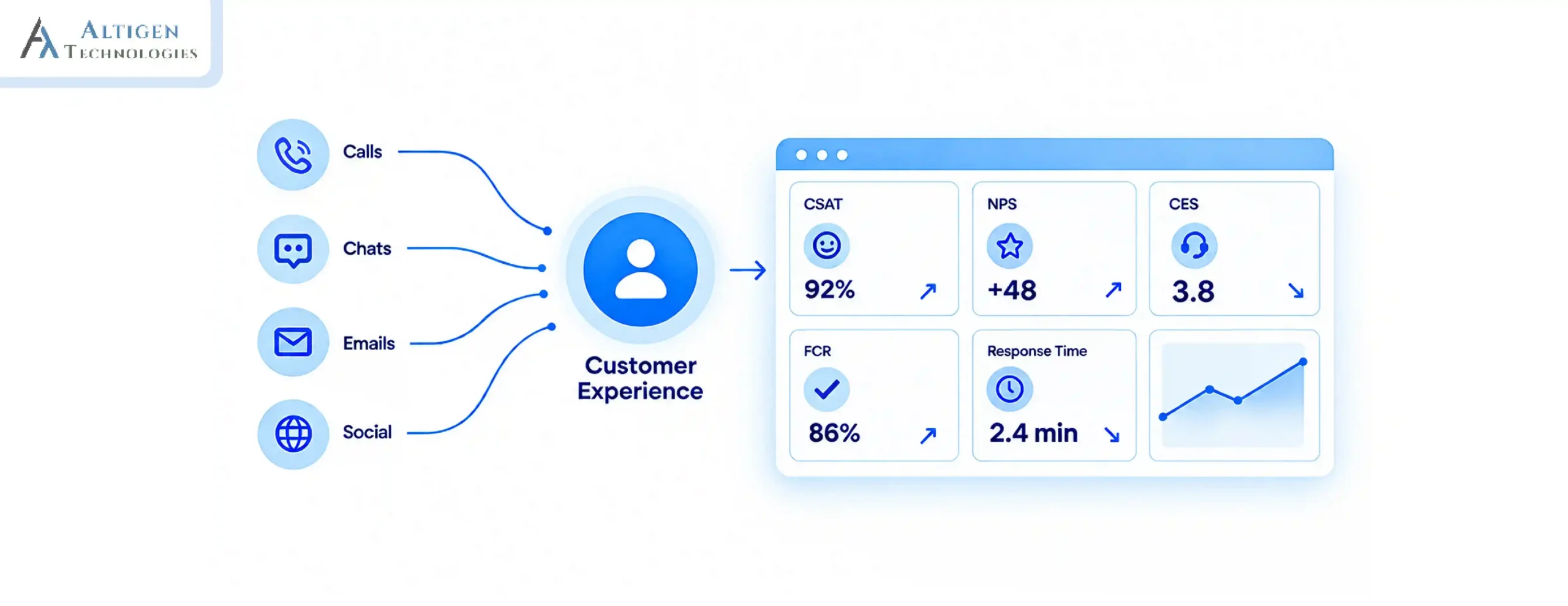
Customers do not adjust their expectations because your agents are working from home. Response times, resolution quality, and service levels are expected to remain the same whether your team is on-site, remote, or split across both.
Managing that reality is one of the key challenges of call center ,workforce management in 2026. Hybrid work is now the operating model for most contact centers. According to Gitnux’s 2025 hybrid work report, 89% of companies see hybrid work as a permanent part of their customer service strategy.
Traditional spreadsheets and fixed shift schedules are not effective for hybrid call center environments. This guide explains how call center workforce management has evolved for hybrid environments, the challenges distributed teams face, how effective workforce management simplifies day-to-day call center operations, and what to look for when choosing a solution for your business.
| Quick Takeaway AI-powered workforce management improves forecast accuracy, automates scheduling, and helps contact centers maintain service levels and reduce labor costs. Real-time adherence monitoring and intraday staffing adjustments help supervisors respond quickly to call spikes and agent absences in hybrid call centers. The right workforce management solution should offer AI forecasting, seamless integrations, real-time analytics, enterprise-grade security, and cloud scalability. Workforce management mistakes like static forecasting, generic shrinkage models, and proximity bias can reduce productivity, employee engagement, and customer experience. |
What is call center workforce management?
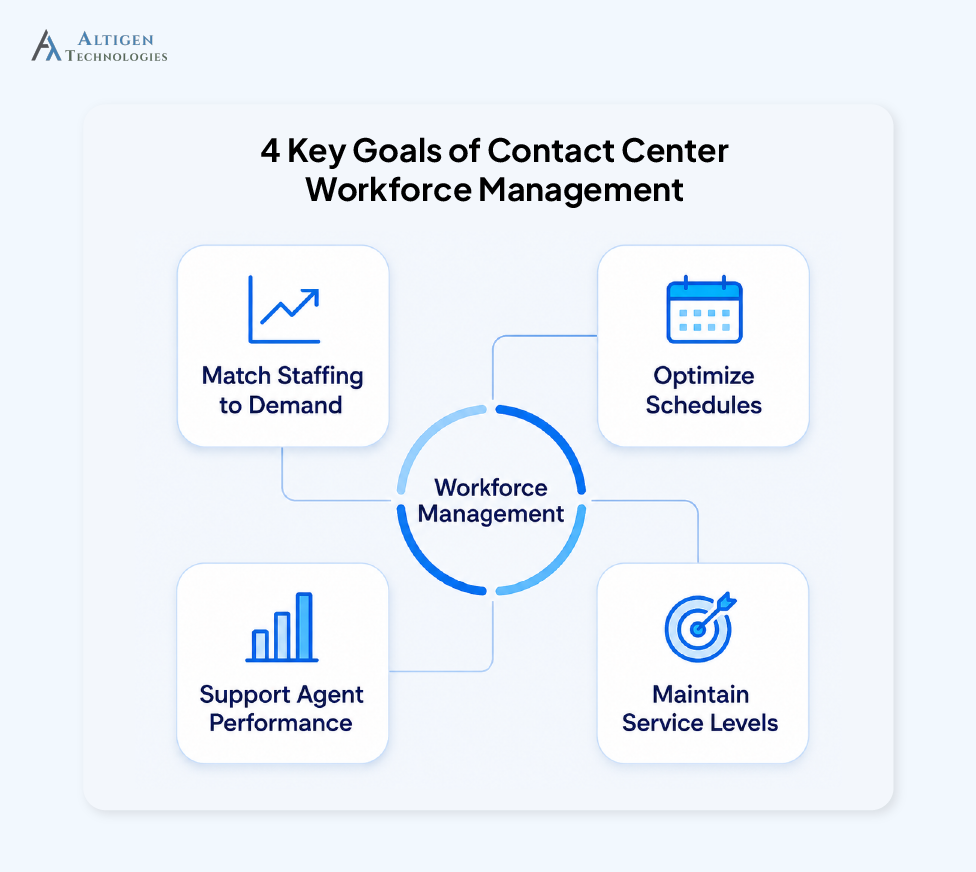
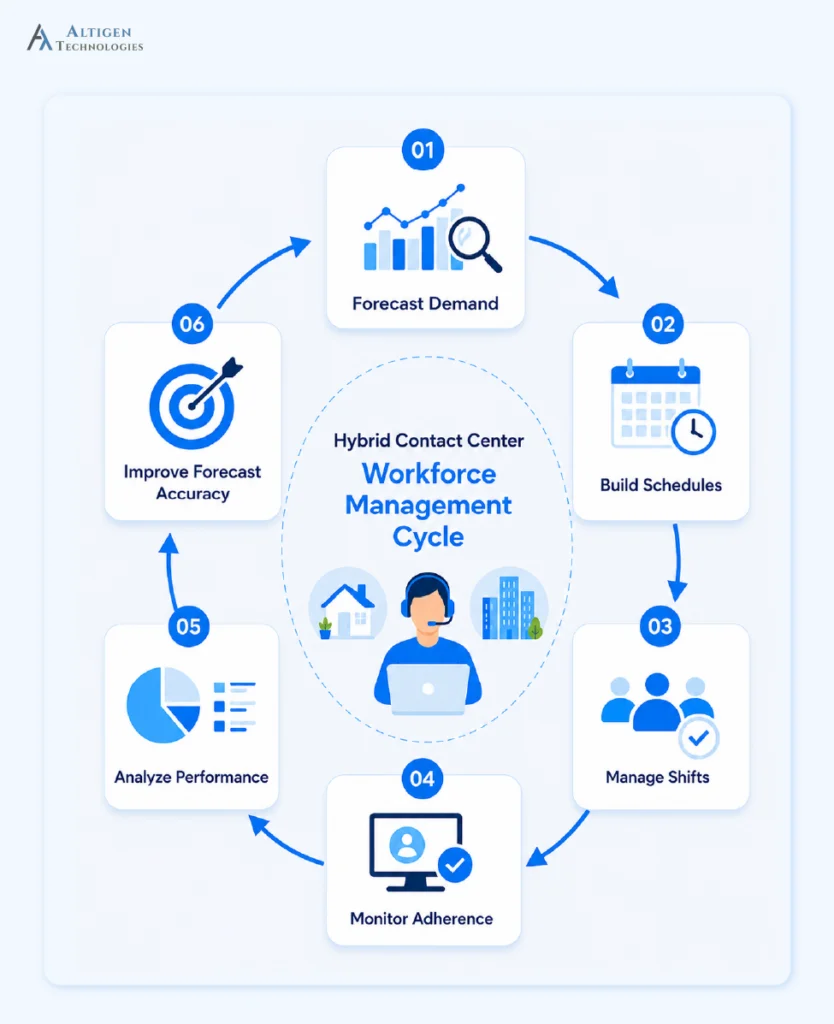
Call center workforce management (WFM) is the set of processes, tools, and strategies that ensure the right number of agents, with the right skills, are available to meet customer demand. It covers the full operational cycle, from predicting how many interactions will arrive to optimizing how agents are scheduled, monitored, and developed.
In a hybrid environment, contact center WFM helps you track whether agents are working remotely or on-site, not just whether they are available.
How workforce management software improves hybrid call center operations
Workforce management software moves the WFM cycle from manual processes to automated, data-driven operations. In hybrid environments, it gives supervisors real-time visibility into remote and on-site agents, making it easier to manage performance and staffing.
1. Automating demand forecasting
WFM software uses historical interaction data, seasonal patterns, marketing calendars, and real-time channel inputs to forecast customer demand more accurately. This helps contact centers schedule the right number of agents, improve service levels, and control labor costs.
- Uses AI to predict demand based on historical trends and real-time data
- Accounts for different shrinkage rates for remote and on-site agents
- Reduces understaffing, overstaffing, and unnecessary labor costs
2. Optimizing agent schedules
Building schedules manually is more complex in hybrid contact centers. The reason is that managers have to maintain balance between forecasted demand, agent skills, work locations, availability, and labor rules at the same time.
Workforce management solutions automate this process and assign the right agents to the right queues based on their skills through skill-based routing, reducing misrouted interactions and improving first call resolution.
3. Monitoring schedule adherence in real time
Workforce management systems give supervisors real-time visibility into agent availability and schedule adherence for both remote and on-site agents. This also helps managers identify deviations as they happen and take corrective action.
For example, suppose a remote agent is scheduled to start at 9:00 a.m. but hasn’t logged in due to an internet outage. The system immediately alerts the supervisor, who can reassign interactions or move another qualified agent into the queue before wait times increase and SLAs are affected.
4. Managing intraday reallocation
Customer demand does not follow the forecast exactly. Unexpected call spikes, agent absences, or system outages can quickly make queues understaffed and the impact compounds fast. Workforce management solutions help supervisors monitor staffing in real time, identify gaps early, and reallocate resources before service levels are affected
5. Workforce analytics and performance insights
Hybrid contact centers generate large amounts of workforce data. The AI-powered WFM system consolidates forecasting, scheduling, adherence, and staffing data into key insights, helping managers identify trends and make better workforce planning decisions over time.
For instance, a manager notices that a particular support queue consistently misses its service level every Monday morning. Historical workforce reports reveal the forecasts underestimate demand during that period, allowing future schedules to be adjusted before the issue recurs.
Common workforce management challenges in hybrid call centers
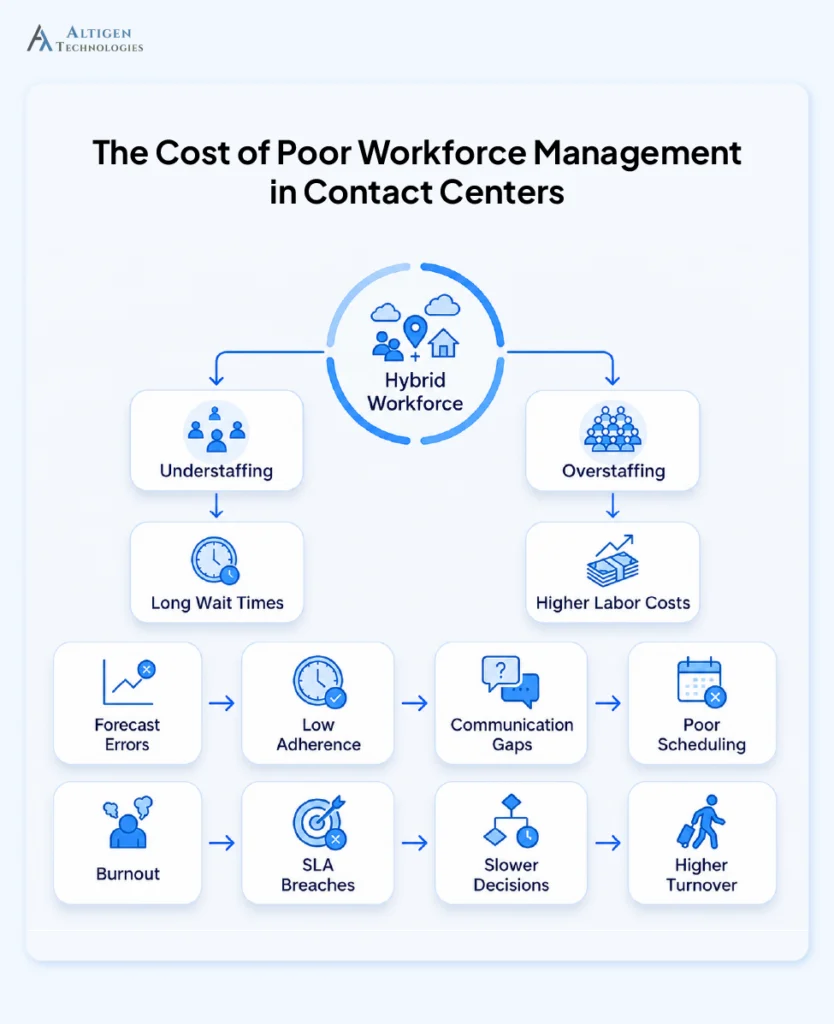
The common workforce management challenges in hybrid work include understaffing during peak demand, overstaffing, inaccurate forecasting, low schedule adherence, communication gaps, and agent burnout.
Understaffing during peak demand
Understaffing is one of the main reasons for service level failures. When volume spikes and agents are not available, queues grow, customers abandon calls. Also, the agents who are working face unsustainable pressure.
Overstaffing and rising labor costs
Overstaffing is the opposite problem but equally damaging. Scheduling too many agents for a given period wastes labor budget and reduces agent utilization.
Forecasting inaccuracies
When demand forecasts are inaccurate, it affects every decision that follows, from scheduling and staffing to leave approvals.
Digital Minds BPO’s 2026 call center statistics report found that 60% of failed first contact resolutions are due to non-availability of right data and resources. This shows how poor workforce planning can impact customer service.
Low schedule adherence
Low schedule adherence disrupts workforce plans, even when forecasts are accurate. In hybrid call centers, delayed logins, extended breaks, and unexpected offline time can increase wait times and put additional pressure on available agents.
Communication gaps
Hybrid teams create coordination complexity that on-site contact centers do not face. Supervisors cannot observe remote agents directly, making it difficult to intervene in real-time.
High agent burnout and turnover
Agent burnout and turnover are the most costly operational problem in contact centers. According to Insignia Resources’ 2026 call center turnover analysis, annual turnover runs at 40 to 45% in 2025-2026, with replacement costs reaching $10,000 to $20,000 per agent in direct expenses.
Essential features to look for in call center scheduling software
When evaluating software for a hybrid contact center, select solutions that can adapt to changing demand, support distributed teams, and integrate with your existing technology stack. Here are the key features you should look for:
1. AI-powered forecasting
Look for a solution that has built-in AI capability to use historical trends and real-time data to improve forecast accuracy and support intraday staffing adjustments.
Suggested Reading: How to Build an AI Contact Center on Microsoft Teams
2. Integrations
Ensure the software integrates with your contact center platform, Microsoft Teams, CRM, HR, payroll, and UCaaS systems to keep workforce data synchronized.
3. Security and compliance
Workforce management solutions handle sensitive employee information, schedules, attendance records, and performance data. That’s why you should look for solutions that meet the following security policies and regulatory requirements.
- Role-based access controls
- Audit logs for user activity
- Data encryption in transit and at rest
- Compliance with industry standards
4. Real-time analytics and reporting
Choose software that offers real-time reports to track forecasting accuracy, schedule adherence, service levels, and workforce performance to support better planning.
5. Scalability
The software should scale with your business without increasing administrative effort or requiring major system changes. This allows you to build a scalable contact center platform that grows with customer demand.
- Supports multi-site and hybrid operations
- Handles growing agent volumes
- Cloud-based deployment for easier expansion
Common WFM mistakes hybrid contact centers should avoid
- Generic shrinkage models: Forecast remote and on-site teams separately because their availability patterns and unplanned absences differ.
- Proximity bias: Assign shifts based on skills, availability, and business needs rather than employee location.
- Ignoring preferences: Consider employee scheduling preferences where possible to improve engagement and reduce absenteeism.
- No mobile self-service: Allow agents to view schedules, request leave, and swap shifts from any device.
- Static Forecasting: Update forecasts throughout the day as contact volumes and staffing needs change.
- Limited skill flexibility: Train agents on multiple skills so teams can respond more effectively to unexpected demand.
- Poor change management: Support WFM implementation with training, internal champions, and regular adoption reviews.
Final thoughts
Hybrid work has changed how contact centers plan, schedule, and manage their workforce. Traditional workforce management systems were designed for on-site teams and do not provide the visibility needed to manage remote and on-site agents effectively.
Altigen provides contact center solutions with AI-powered workforce management capabilities that improve forecasting, optimize schedules, monitor adherence, and provide real-time insights across distributed teams. This helps businesses improve operational efficiency and deliver better customer experiences.
Contact us to build a flexible, scalable workforce management strategy for your hybrid contact center.
Frequently asked questions
Call center workforce management is the set of processes and tools used to ensure the right number of agents with the right skills are available to handle customer interactions at the right times. It includes forecasting, scheduling, intraday management, and performance tracking.
Workforce management solutions automate the forecasting, scheduling, adherence monitoring, and analytics functions of WFM. It replaces manual spreadsheet-based processes with data-driven tools that improve accuracy, reduce manager administrative time, and give agents self-service access to their schedules.
Hybrid work requires managers to consider agent availability, skills, work locations, and demand patterns. Workforce management solutions help create optimized schedules, improve visibility, and maintain consistent staffing coverage.
Call center scheduling solutions should include AI-powered forecasting, location-aware scheduling, real-time adherence monitoring, mobile-first self-service, shift bidding and swapping, supervisor dashboards for distributed teams, and integration with your contact center and UCaaS platforms.
You can start with transparent shift allocation policies, apply the same bidding and assignment criteria to on-site and remote agents, give agents mobile self-service access to manage their own schedules, and use adherence data to identify workload imbalances before they lead to burnout or attrition.
Call centers should monitor service level (80% of calls answered within 20 seconds is the industry standard), schedule adherence (85 to 90% target), occupancy rate (85 to 90% optimal range), average handle time, forecast accuracy, first contact resolution, shrinkage rate, and agent turnover rate.