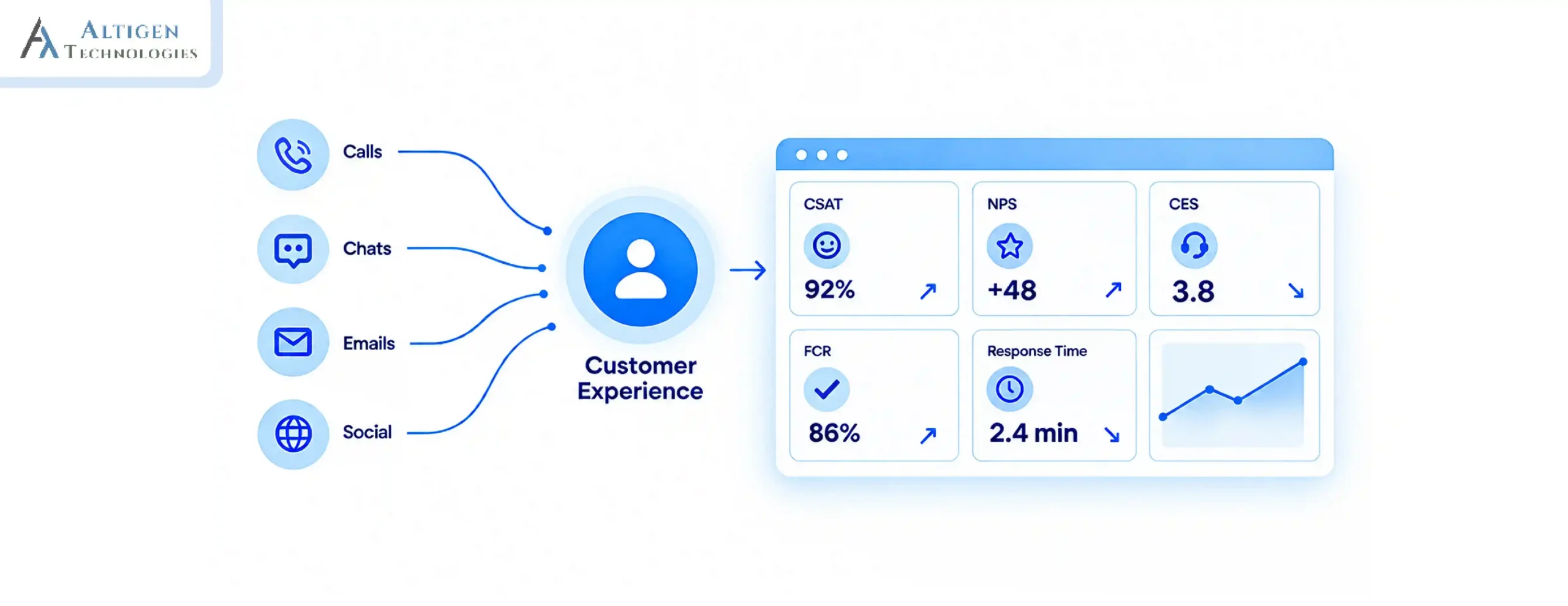
A customer hangs up frustrated. An agent misses a compliance disclosure. A coaching moment that could have prevented both goes unnoticed for weeks. This is what happens when quality assurance depends on manual call reviews.
Most QA teams simply cannot keep up. According to McKinsey & Company, quality assurance in the contact center is “still largely a manual process, prone to human bias and limited by its reliance on small, random samples of customer conversations”. By the time a coach reviews the call, the opportunity for real-time correction has already passed.
Call monitoring software changes this equation. Instead of sampling a handful of calls per agent each month, cloud-based platforms can capture, transcribe, and score every conversation as it happens. This article looks at what call monitoring software actually does, why it matters for quality assurance, and how contact centers can put it to work.
| TL;DR 1. AI-powered call monitoring software can evaluate more customer interactions than manual QA, helping contact centers improve scoring accuracy, coaching, and compliance. 2. An effective QA program includes standardized scorecards, automated workflows, and continuous coaching for consistent agent evaluations. 3. Key features like real-time monitoring, AI-powered quality scoring, speech analytics, and compliance monitoring in call monitoring software help supervisors to identify issues faster. 4. Following best practices such as using consistent evaluation criteria, combining AI with human reviews helps contact centers improve agent performance. |
What is call monitoring software
Call monitoring software is a technology layer that records, transcribes, analyzes, and scores customer conversations across voice and digital channels. In a cloud contact center, it typically combines several capabilities:
- Call recording that captures audio (and often screen activity) for every interaction
- Speech and text analytics that convert conversations into searchable, analyzable data
- AI-driven scoring that evaluates calls against a defined quality rubric
- Live monitoring that lets supervisors listen in on active calls
- Reporting dashboards that surface trends across agents, teams, and time periods
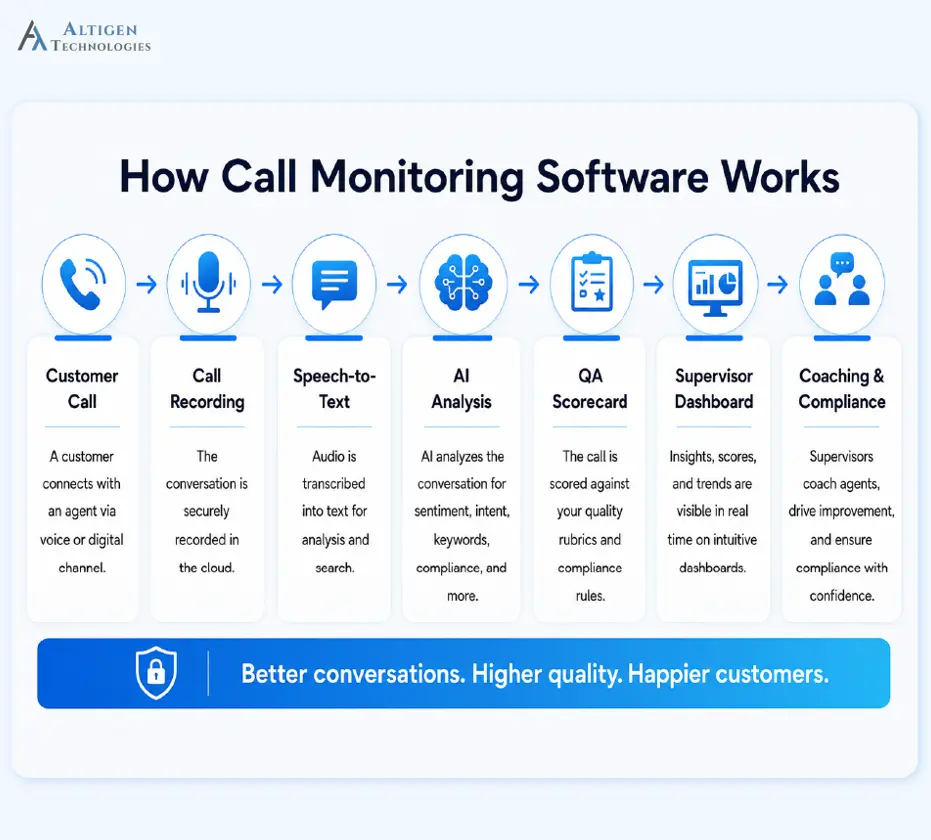
Unlike legacy on-premise recording systems, cloud-based call monitoring tools integrate directly with CCaaS platforms, CRM systems, and workforce management tools. QA data flows directly into coaching workflows, performance reviews, and compliance audits, making it easier for managers to act on insights.
The market reflects this shift. According to Coherent Market Insights, the global contact center analytics market, which includes speech analytics and call monitoring tools, was valued at roughly USD 2.3 billion to 2.7 billion in 2025 to 2026.
Suggested Reading: Cloud Contact Center Migration Guide
How call monitoring software improves quality assurance
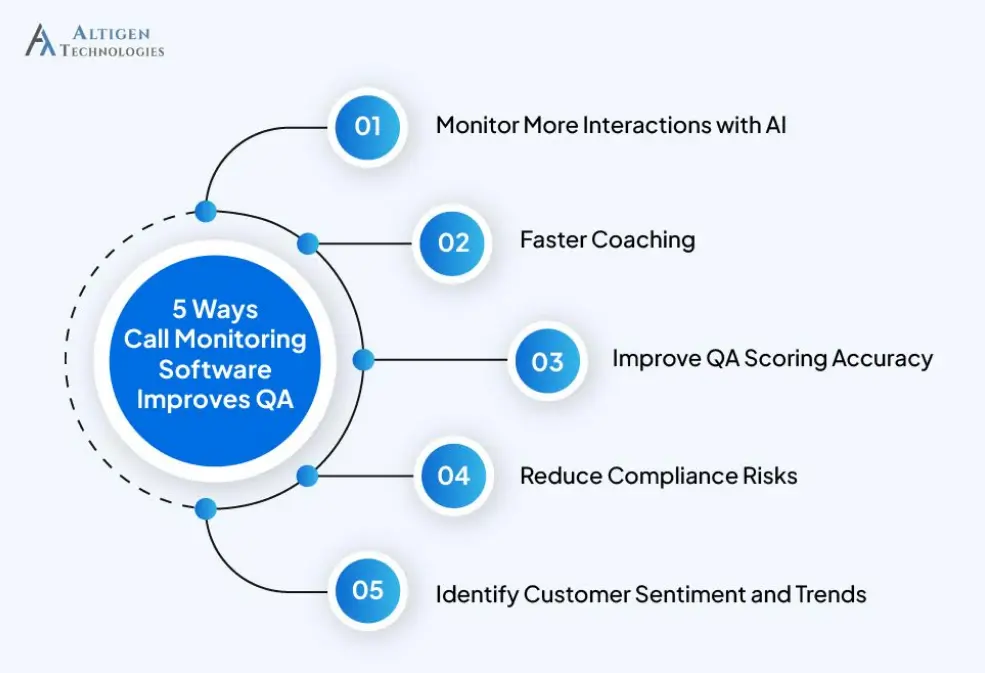
1. Monitor more interactions with AI
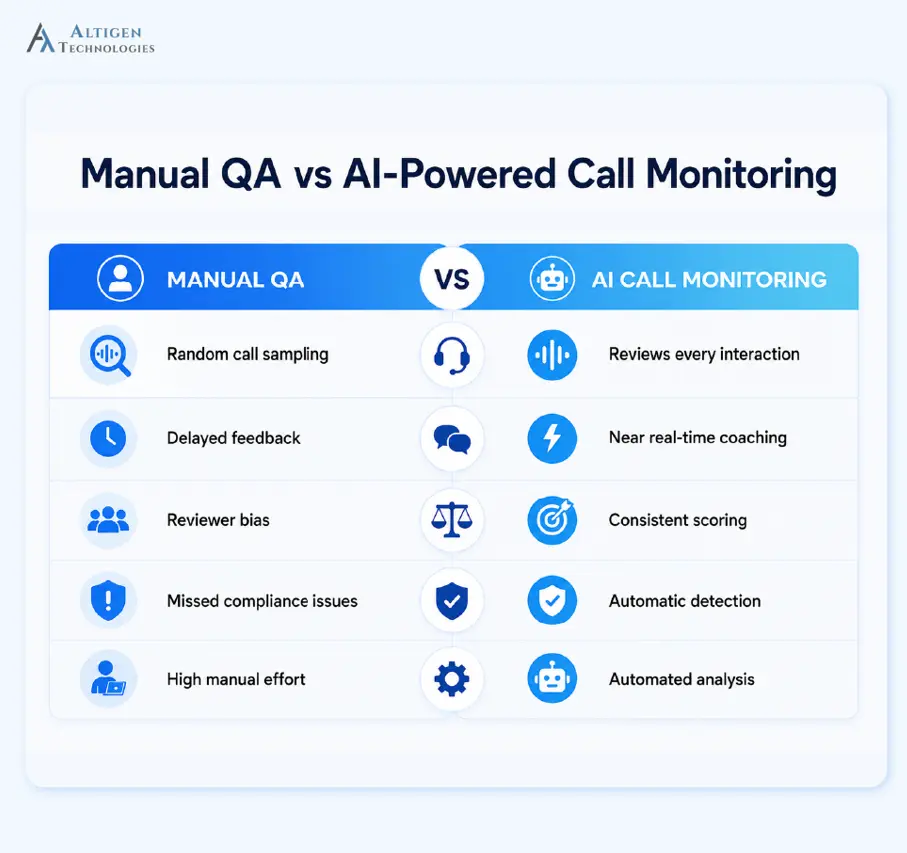
Manual QA teams can review only a small handful of calls per agent each month. According to McKinsey, automated QA processes could achieve more than 90% accuracy compared to 70 to 80% through manual scoring. The benefits include:
- Every call, chat, and email is evaluated using the same criteria.
- Outlier interactions, such as unusually long calls, repeat contacts, or escalations can be flagged automatically for human review.
- QA teams can see a far more complete picture instead of extrapolating from a small sample of total interactions.
2. Faster coaching opportunity
Instead of waiting for a monthly review cycle, supervisors get real-time visibility into performance issues. Automated flagging reveals patterns like rushed call closings, missed upsell opportunities, or repeated customer frustration cues. This helps agents get feedback while the call is still fresh in memory, which improves performance and supports ongoing coaching initiatives.
3. Improve QA scoring accuracy
Manual scoring can be subjective. Two reviewers can listen to the same call and score it differently. Call monitoring software applies the same evaluation criteria across every interaction, regardless of the reviewer. This reduces score disputes because evaluations are linked to specific, timestamped moments in the transcript rather than a reviewer’s general impression.
4. Reduce compliance risks
Meeting regulatory requirements becomes difficult when QA teams review only a small sample of customer interactions. Missed disclosures, mishandled payment information, or unauthorized statements can expose contact centers to penalties, customer complaints, and legal disputes. Call monitoring software checks conversations against predefined compliance rules, helping teams identify issues early. Here is how it helps:
- Supports HIPAA, PCI DSS, and industry-specific compliance requirements
- Stores searchable call recordings and transcripts
- Creates an audit trail for investigations and disputes
5. Identify customer sentiment and trends
Modern call monitoring tools provide sentiment analytics that help contact centers identify recurring patterns, making it easier to understand why customers are satisfied, frustrated, or contacting repeatedly. These insights help QA teams improve agent coaching, refine scripts, and address operational issues that affect customer experience.
For example, a bank notices that customers calling about declined credit card transactions frequently express frustration. After reviewing the conversations, the QA team found that agents were giving inconsistent explanations of the verification process. To address this, the bank updates its call script and self-service FAQs, helping agents resolve queries faster, reduce Average Handle Time (AHT), and improve customer satisfaction.
How to build an effective QA program with call monitoring software
Setting up a QA program requires clear evaluation criteria, a consistent review process, and timely coaching to help agents improve. Here’s how to build an effective QA program.
Step 1. Define quality standards before configuring software
Define the criteria you will use to evaluate customer interactions before configuring the software. Everyone involved in QA should agree on the same standards so reviews remain consistent.
Step 2. Configure call recording for full coverage
Set recording to capture every interaction across every channel: voice, chat, email, and social if you are looking to deploy an omnichannel contact center. Before going live, confirm that compliance-grade settings are active, including defined retention periods, role-based access controls, and tamper-proof storage.
Step 3. Build your QA scorecard inside the software
Create a QA scorecard with 7 to 10 evaluation criteria. Test it with a small group of reviewers before rolling it out across the team. Keeping the scorecard focused makes evaluations more consistent and easier to apply.
Step 4. Automate coaching workflows
Configure automated coaching workflows that notify supervisors, assign coaching sessions, and track improvement after QA scores are generated.
Step 5. Connect QA scores to coaching
Use AI to evaluate routine customer interactions and keep manual reviews for high-risk, complex, or disputed calls. This approach helps QA teams review more interactions and ensure critical conversations are evaluated effectively.
Key features to look for in call monitoring software
When evaluating call monitoring software, look for features that improve quality assurance, simplify compliance, and help supervisors coach agents more effectively. Here are the most key capabilities you should consider.
- Real-time call monitoring: Listen to live customer calls and step in when immediate support or intervention is needed.
- Call recording and playback: Access searchable, timestamped recordings and transcripts across voice and digital channels.
- AI-powered quality scoring: Automatically evaluate customer interactions using a consistent, customizable QA scorecard.
- Live coaching and agent assistance: Provide whisper coaching or on-screen guidance to agents during active customer conversations.
- Agent performance analytics: Track individual and team performance with dashboards that highlight trends and coaching opportunities.
- Compliance monitoring: Detect missed disclosures, monitor sensitive information, and support regulatory requirements such as HIPAA and PCI DSS.
Suggested Reading: How to Evaluate Contact Center Software for Enterprise
Best practices for using call monitoring software
Getting the software right is only half the job. How a team uses it determines whether QA actually improves.
- Use consistent QA scorecards. Changing criteria mid-quarter makes it impossible to compare performance over time.
- Review both good and poor calls. Studying strong interactions is just as valuable for coaching as studying weak ones.
- Combine AI with human evaluation. AI catches scale; humans catch nuance and context that a rubric can miss.
- Coach regularly, not just after failures. Frequent, short coaching sessions outperform infrequent, long ones.
- Track trends, not just individual scores. A single low score matters less than a pattern across weeks.
- Share QA feedback quickly. The value of near real-time monitoring disappears if feedback still takes two weeks to reach the agent.
Final takeaway
Manual QA reviews were never designed to keep pace with modern call volumes, and the gap between what they can cover and what actually needs oversight keeps widening. Call monitoring software closes that gap by evaluating more customer interactions, surfacing coaching opportunities faster, and giving compliance teams a defensible audit trail, all without adding headcount to already stretched QA teams.
For contact centers weighing the investment, the numbers make a strong case. Agent attrition alone costs the industry billions annually, and much of that turnover traces back to agents who never got timely, consistent feedback. Call monitoring software doesn’t just catch problems. It gives supervisors the tools to prevent the next one.
Frequently asked questions
It gives supervisors visibility into far more interactions than manual reviews allow, which improves consistency, compliance, and coaching speed while reducing the risk of undetected customer experience or regulatory issues.
Start with a clear, calibrated scorecard, expand coverage using AI-powered scoring so more calls get reviewed, and connect every flagged interaction to a coaching workflow so feedback actually reaches agents.
By automatically flagging missed disclosures, negative sentiment, and coaching opportunities in real time, so supervisors can act on issues within days instead of discovering them during infrequent audits.
Reduce time spent on repetitive tasks through AI-assisted scoring and real-time prompts, pair this with regular, targeted coaching, and use trend data to identify and fix systemic process issues rather than individual blame.
First call resolution (FCR), average handle time (AHT), customer satisfaction (CSAT), and service level (the percentage of calls answered within a target time).
It’s a commonly used service level target meaning 80% of calls should be answered within 20 seconds, used as a benchmark for responsiveness and staffing adequacy. This is an industry convention rather than a figure tied to one specific published study.
Yes. AI-powered speech analytics can transcribe, score, and flag calls against a defined scorecard without human involvement in the first pass, reserving human review for ambiguous, high-risk, or disputed interactions.