You may think building an AI voice agent gives your team control over its capabilities, while buying one helps you deploy it faster. But is the decision that simple?
Both options involve costs beyond the initial setup. Your team still needs to manage integrations, update knowledge, test responses, and fix failures as customer needs change.
Selecting the right approach depends on your technical resources, customization requirements, budget, and ability to maintain the agent after launch.
In this guide, we compare building, buying, and using a managed service for AI voice agents across costs, implementation timelines, and long-term ownership to help you make an informed decision.
| Quick Summary 1. Building an AI voice agent offers greater control over its architecture and customization but requires significant engineering effort and ongoing maintenance. 2. Buying a platform reduces development work, though integration fees, usage charges, and internal management still add to the cost. 3. With a managed service, the provider sets up and manages the agent, while your business controls the customer experience and expected results. 4. Compare the three options based on total cost, customization, integration requirements, ongoing responsibilities, and pilot performance. |
What are different ways to implement an AI voice agent?
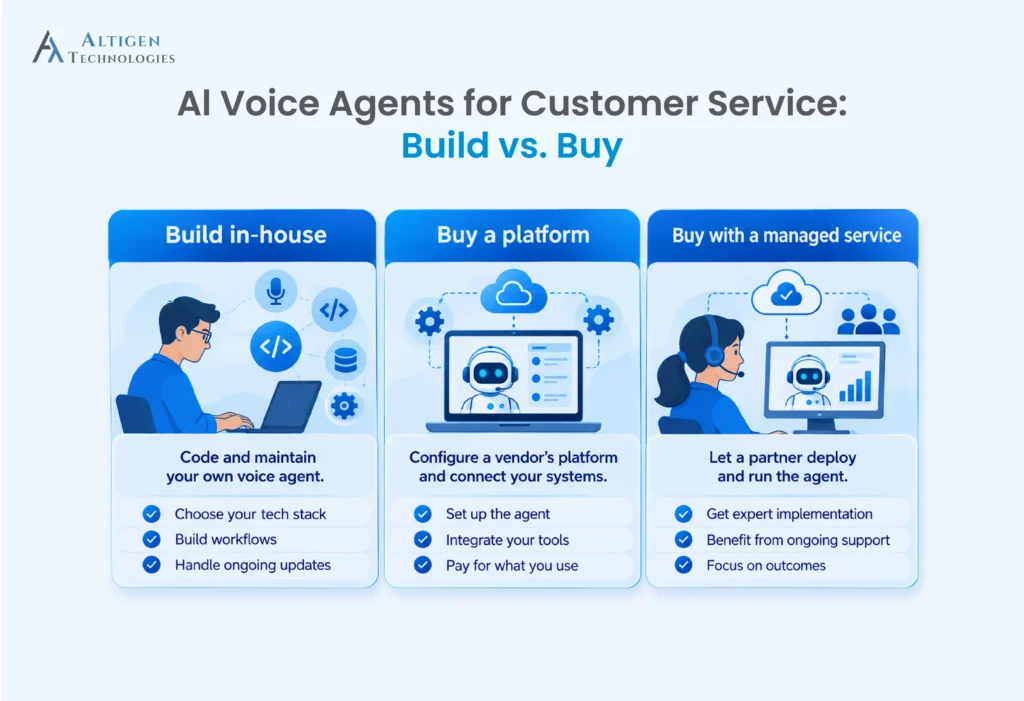
There are three ways to get an AI voice agent into production, depending on how much development and operational responsibility your team wants to take on.
- Build in-house: Develop the voice agent using your own speech recognition, language model, text-to-speech, telephony, and business system integrations. Your team handles deployment, testing, and maintenance.
- Buy a platform: Subscribe to a vendor’s voice agent platform and configure its capabilities, workflows, and integrations to meet your requirements. Your team manages the agent, while the vendor maintains the underlying platform.
- Managed service: Use a vendor or implementation partner to configure, deploy, and operate the agent. Your business retains control of its policies, customer experience, and expected outcomes.
AI voice agent: build vs buy vs managed service: key differences
Here are the major differences between building, buying, and using a managed service for an AI voice agent.
| Decision factor | Build in-house | Buy a platform | Managed service |
| Initial investment | Highest, mostly engineering time | Platform and implementation fees | Platform fees plus service retainer |
| Deployment time | Longest, set by development and testing | Faster, set by integrations | Faster, set by partner capacity |
| Technical expertise | Internal AI and voice engineering team | People to configure, monitor and QA | Minimal internal technical need |
| Customization | Full control of architecture and logic | Bounded by platform capability | Bounded by platform, delivered for you |
| Integrations | Built and maintained internally | Prebuilt connectors plus custom work | Partner builds and maintains |
| Maintenance | Entirely yours | Vendor runs the platform, you run the agent | Partner runs the agent, you review it |
| Scalability | Your infrastructure and planning | Vendor capacity, pricing and platform limits | Vendor capacity plus partner bandwidth |
| Security and compliance | You own every control | Shared responsibility, documented in contract | Shared across three parties |
| Ownership after launch | An engineer on call for production issues | An in-house owner for setup and QA | Partner runs the agent, and someone on your side reviews calls |
Suggested Reading: How to Build an AI Contact Center on Microsoft Teams
How much does it cost to build vs. buy an AI voice agent?
When implementing an AI voice agent, you should compare the cost over a fixed twelve or twenty-four month window rather than at the point of purchase.
1. Costs involved in building an AI voice agent
The cost of building an AI voice agent is the total cost you pay for engineering time, speech services, language model usage, telephony, integrations, security controls, and ongoing maintenance. The total depends on call volume, how many systems the agent connects to, and the size of the team you need.
One-time build costs
- AI and voice engineering salaries, plus the product and QA time around them
- CRM and business system integrations, each built and maintained separately
- Testing, logging, and security controls
Recurring costs
- Speech-to-text and text-to-speech usage, billed per minute or per character
- Language model usage, which rises with call volume and prompt length
- Telephony infrastructure and per-minute call charges
- Ongoing maintenance, which does not stop once the agent is live
To estimate your first-year cost, add the one-time build costs to twelve months of recurring costs.
2. Costs involved in buying an AI voice agent platform
When you buy an AI voice agent platform, you pay the vendor for access to its technology. However, the subscription is not the only expense. You also pay for integration. According to a Gartner report, the cost of integrating conversational AI into a contact center at $1,000 to $1,500 per agent.
Beyond the subscription, ask what else appears on the bill.
- Per-minute or per-call usage charges, and what happens above your tier
- Setup, onboarding and implementation fees
- Custom integration work for anything without a native connector
- Charges for extra channels, languages or premium voices
- Support tiers, where faster response times cost more
Hidden costs of buying an AI voice agent
Buying removes the infrastructure work but does not remove the operating work entirely, and this is the cost almost no vendor comparison quantifies.
Someone inside your organization still needs to write and revise the agent’s instructions, keep its knowledge current as policies change, listen to recorded calls for quality, and decide what to change next. If your pricing changes quarterly and the knowledge base is not updated the same week, the agent confidently quotes last quarter’s figures.
When is building an AI voice agent cheaper than buying?
Building an AI voice agent can be cheaper when your business handles high volumes of predictable calls, has an experienced engineering team, and can reuse existing integrations and infrastructure.
Buying is more cost-effective when call volumes are lower or your team lacks the resources to maintain custom AI voice agents. Compare the total costs of both approaches over the same 12-month period before making a decision. To compare the total costs of both models over the same 12-month period, consider these five factors:
- Monthly call volume and average call length
- Your platform’s per-minute or per-call rate
- Fully loaded internal engineering cost
- Expected maintenance hours after launch
- How much custom integration work either path needs
When should you build, buy or use a managed service?
When building is the right choice
Building is the right call only under specific conditions, and all of them need to apply.
- You already employ an experienced AI and voice engineering team
- Your workflows are proprietary enough that no platform models them
- You have specific infrastructure or data residency requirements
- The voice agent is part of your product rather than your support function
- You can fund maintenance for years, not just the build
When buying can be the ideal option
Buying an AI voice agent is usually the better option when you want to automate customer interactions using an existing solution rather than develop and maintain the technology in-house.
Consider buying when:
- Your workflows are established: You need to automate existing customer service or support processes rather than build highly specialized voice experiences.
- You want to avoid infrastructure development: Your team would rather configure an existing platform than develop speech recognition, telephony, integrations, and other components from scratch.
- You have limited engineering capacity: You cannot dedicate developers to building, testing, and maintaining a custom voice agent.
- You need existing system integrations: The agent must connect with your CRM or contact center without extensive custom development.
When a managed service is preferred
A managed service is a suitable option when your business knows what it wants to automate but lacks the internal resources or expertise to operate an AI voice agent. Consider this approach when:
- You lack an internal owner: Your team doesn’t have the time or expertise to manage agent configuration, integrations, monitoring, and ongoing improvements.
- Operational risks are high: Your business operates in a regulated environment where configuration errors, inaccurate responses, or compliance failures could have serious consequences.
- You need support during the initial deployment: You want an experienced provider to implement and manage the agent while your team develops the capabilities to build and manage it.
What should you evaluate when choosing an AI voice agent solution?
When selecting an AI voice agent, you should consider the following key factors.
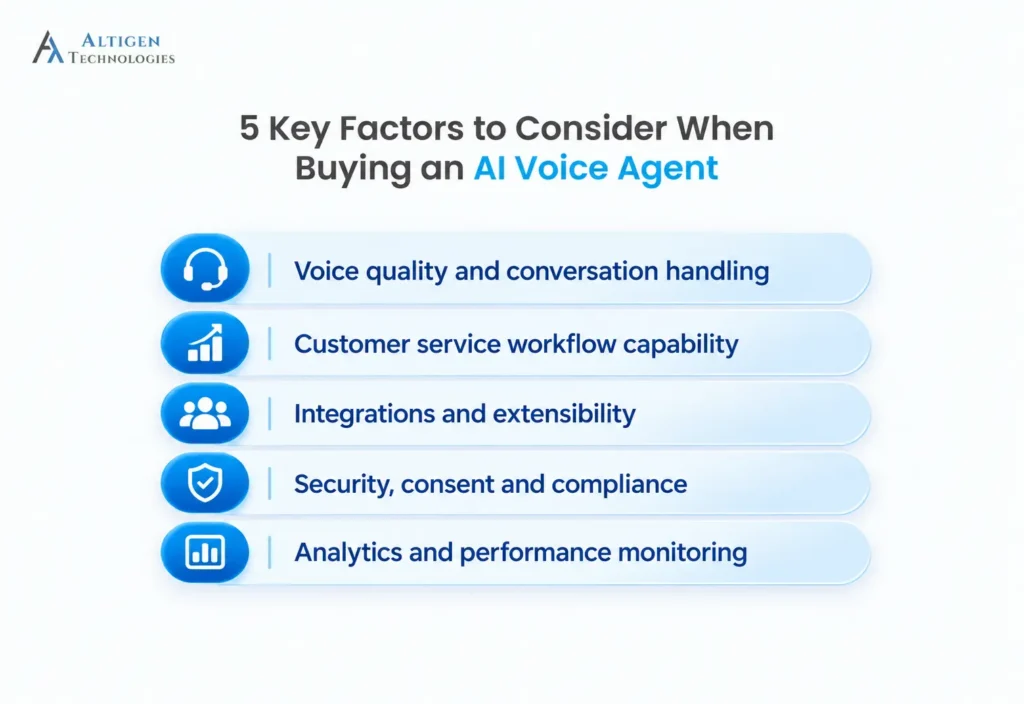
1. Voice quality and conversation handling
A voice agent needs to handle conversations naturally, including interruptions, pauses, accents, and background noise. A product demo may not reveal how well it handles these situations, so test it yourself.
Call the agent and talk over it mid-sentence. A capable agent stops and listens. A poor one finishes its scripted line while the caller repeats themselves. Then go quiet for a few seconds, use a strong regional accent, and call from a noisy room.
2. Customer service workflow capability
An AI voice agent’s ability to answer questions doesn’t necessarily mean it can resolve customer requests. For example, an agent might explain how to dispute a charge but lack the ability to verify the transaction, authenticate the caller or submit the dispute. These actions require access to customer records, business systems and predefined workflows. When evaluating the agent, check whether it can:
- Handle common customer requests, such as billing inquiries, appointment scheduling and order or application status checks.
- Retrieve customer information from connected CRM, help desk or other business systems.
- Update records, trigger workflows and complete service actions during a call.
- Verify caller identity and enforce permissions before performing sensitive actions.
- Recognize requests it cannot resolve and transfer the call to a human agent with the relevant customer details and conversation history.
3. Integrations and compatibility
An AI voice agent needs access to your existing business systems to retrieve customer information, update records and complete service requests. Its integration capabilities determine how well it fits into your current technology environment and how much additional development is required. AI customer service voice agents integrate with other applications in three main ways:
- Native integrations: Built and maintained by the AI voice agent provider.
- Third-party connectors: Use external platforms to connect applications and may involve additional fees.
- Custom API integrations: Developed for specific requirements and may need ongoing maintenance.
Before committing, clarify which integration method applies, whether additional licensing or implementation fees apply, and who will maintain custom connections.
4. Security, consent and compliance
Security and compliance are essential when an AI voice agent handles customer conversations, particularly when calls involve personal or financial information. Encryption and access controls are basic requirements, but you also need to understand how the platform handles call recording, AI disclosure and data retention.
If your business operates in regulated sectors such as healthcare or financial services, check whether the platform supports the compliance requirements applicable to your industry.
For example, banks evaluating AI voice agents for customer service need to ensure proper authentication, fraud monitoring, and compliance with applicable regulations.
Suggested Reading: How AI is Transforming Banking Contact Centers
5. Analytics and performance monitoring
You need to measure the performance of an AI agent beyond the number of calls it handles. The right call center metrics help you find whether the agent resolves customer requests, when it needs human assistance and where interactions fail. The following metrics help assess its effectiveness:
- Resolution rate, defined as requests completed, not contacts that avoided a human
- Transfer and escalation rates, and whether escalations arrive with context
- Customer satisfaction scored on AI-handled calls only, never blended with human calls
- Failed interactions and recurring error patterns
- Usage and cost reporting, broken down by channel
How to test an AI voice agent before deployment?
To test an AI voice agent, run a pilot on one call type before expanding its use across other customer service workflows. Here are eight steps to cover the testing process.
- Pick one specific customer service use case with real volume
- Prepare representative call scenarios, including awkward and ambiguous requests
- Test latency, voice quality and interruption handling
- Check whether the agent completes the workflow correctly, not just whether it answers
- Test CRM updates, data retrieval and every other integration in scope
- Verify human handoff, and what happens when an action fails midway
- Review the call recordings and performance reports yourself rather than reading a summary
- Estimate your cost from actual pilot usage rather than the quoted rate
How does Altigen CoreInteract help businesses develop AI voice agents?
Altigen CoreInteract provides a platform for businesses to build AI agents across voice and digital channels. Altigen also offers AI consulting and managed services to help your internal teams. Its capabilities address several of the evaluation criteria discussed above:
- Structured agent development: A visual interface, workflow builder, and prebuilt agents help teams configure voice agents without developing the entire system from scratch.
- Omnichannel support: Businesses can use voice, SMS, chat, and email agents, helping maintain consistent workflows across customer service channels.
- Contextual handoffs: Unresolved interactions can transfer to CoreEngage with the relevant context intact, reducing the need for customers to repeat information when speaking to a human agent.
- Performance reporting: Reports cover activity, first contact resolution by channel, and model cost and usage by channel, giving teams visibility into agent performance and operating costs.
Suggested Reading: How to Deploy Omnichannel Contact Center on Microsoft Teams
Final takeaway
The decision to build or buy an AI voice agent affects your budget, deployment timeline and long-term responsibilities. Before choosing between these options, you should assess five factors: technical capabilities, costs, customization needs, deployment timelines, and post-launch ownership.
If you are looking to deploy an AI voice agent without building the technology from scratch, schedule a demo with the Altigen team to see how CoreInteract fits your requirements. Contact us today.
Frequently asked questions
Buying reduces initial development costs because you pay for an existing platform rather than investing in the engineering resources, infrastructure and development required to build an AI voice agent from scratch. Building can become cheaper at high call volumes because engineering costs are largely fixed while usage charges increase with consumption. Compare both approaches over twelve months using your expected call volume and average call length.
The time to build an AI voice agent depends on your requirements. A production-ready AI voice agent can take from a few weeks to months because it needs development, telephony integration, connections to business systems, workflow configuration, security checks and testing across different call scenarios.
Building an AI voice agent requires skills in AI/ML engineering, speech recognition, natural language processing, text-to-speech, telephony integration, API development and backend programming. You also need experience with CRM and business system integrations, testing, security and production monitoring to deploy and maintain the agent reliably.
Yes. Most AI voice agent platforms allow businesses to customize agent instructions, knowledge sources, conversation flows, workflows, integrations and escalation rules. However, the level of customization depends on the platform. Some providers allow custom API integrations and workflow changes, while others restrict access to the underlying models, architecture or system logic.
If you leave an AI voice agent platform, your ability to retrieve and reuse data depends on the provider’s data retention and export policies. Before signing a contract, confirm whether you can export agent instructions, knowledge content, call recordings, transcripts and performance history in structured, usable formats.
Yes, you can start with a purchased AI voice agent platform and add custom capabilities as its requirements evolve. For example, it can use the platform’s existing voice infrastructure and workflows initially, then develop custom API integrations or features for specific business processes. As the business develops its technical capabilities, it can gradually take on more feature development and maintenance in-house.