Artificial intelligence has come a long way in the last decade, especially in the field of conversational AI. Early chatbots such as ELIZA, released in the 1960s, used pattern matching and scripted responses to simulate conversation. These systems could respond to specific inputs, but there were many limitations in understanding meaning or maintaining context.
Today, large language models (LLMs) such as GPT-4 can interpret complex requests, consider conversational context, and generate detailed responses. This evolution has been shaped by two major advancements: moving from matching words and patterns to understanding language and meaning.
In this guide, we will explore how natural language processing, transformers, foundation models, and other technologies have shaped conversational AI, how LLMs have changed its capabilities, and what businesses should consider before implementing these systems.
| TL;DR – A Quick Takeaway 1. Conversational AI has evolved from keyword matching and scripted responses to systems that can understand intent, context, and nuanced requests. 2. Five technologies shaped modern AI: transformer architecture, GPU-accelerated computing, foundation models, retrieval-augmented generation (RAG), and multimodal AI. 3. LLMs expanded conversational AI with semantic understanding, contextual memory, personalization, complex problem solving, and more natural interactions. 4. Businesses should assess key factors before implementation, including use cases, data and integrations, security and privacy, and ongoing improvement. |
The Early Days of AI: Keyword Recognition
The first wave of conversational AI relied heavily on keyword recognition and predefined scripts. For example:
User: “I’m feeling sad today.” Chatbot: “Why do you say you’re feeling sad?”
While this response seems appropriate at first glance, the chatbot wasn’t truly “understanding” the user’s input. It simply matched the keyword “sad” to a prewritten response. These systems lacked the ability to:
- Understand context: If the user continued the conversation with, “I lost my job,” the chatbot would often fail to make the connection and offer a meaningful follow-up.
- Adapt dynamically: Conversations felt stilted because the chatbot treated each user input as isolated and unrelated to previous ones.
- Handle complexity: Multi-step reasoning or nuanced queries were beyond their scope.
How Natural Language Processing (NLP) Changed Conversational AI
Conversational AI didn’t become useful overnight. For years, chatbots followed rigid scripts and failed the moment a customer phrased a question differently from the scripted ones. The change came through steady advances in natural language processing, the technology that lets machines actually parse and generate human language rather than just matching keywords.
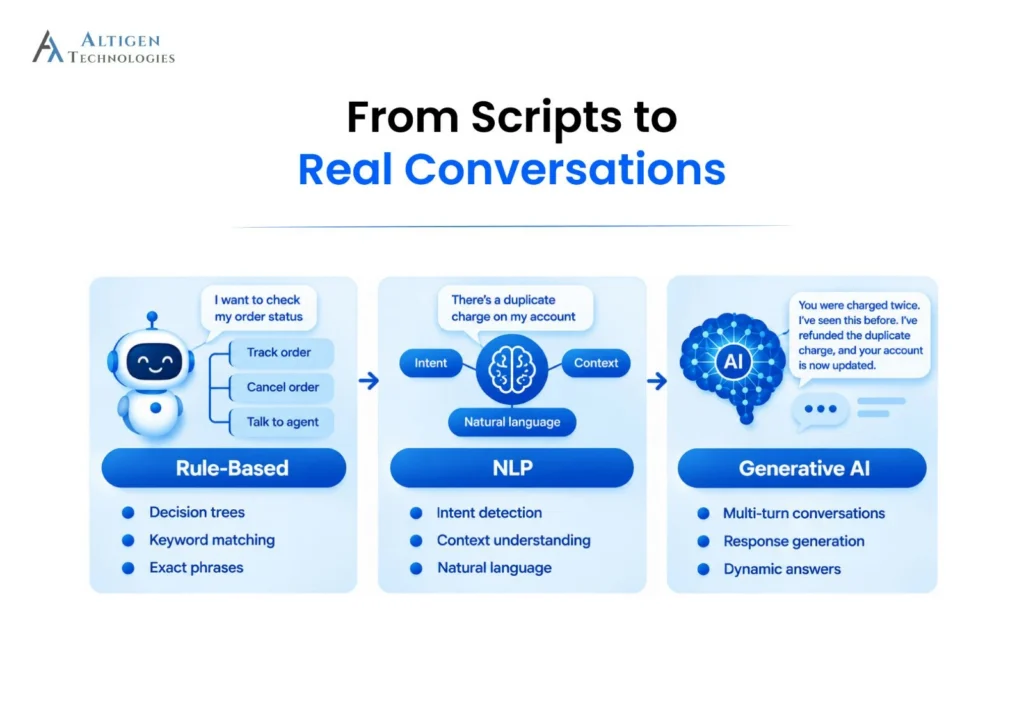
From rule-based scripts to real language understanding
- Early chatbots relied on decision trees and keyword matching. If a customer’s words didn’t match a pre-written pattern, the system failed or looped back to a generic response.
- NLP introduced the ability to interpret intent, not just words. A system could now understand that “why was I charged twice” and “there’s a duplicate charge on my account” mean the same thing.
- This shift moved conversational AI from answering exact-match questions to handling the actual variety of how people naturally speak.
Generative capability expanded what NLP does
- Older NLP mostly focused on reading and classifying language: sorting a support ticket into a category, detecting sentiment, or pulling a keyword from text.
- Generative AI modified NLP from reading and classifying language toward actually producing it, opening up categories of application in content generation, knowledge management, conversational AI, and document intelligence, per the same MarketsandMarkets analysis.
- That change is why a modern virtual assistant can hold a multi-turn conversation and draft a full response, instead of retrieving one static answer from a database.
Real numbers show how NLP is now embedded in customer service
- 69% of service professionals report that their organization uses at least one form of AI, according to Salesforce’s 7th State of Service report.
- Service teams estimate AI currently handles 30% of customer service cases, and expect that figure to reach 50% by 2027, based on the same Salesforce research.
- The Markets and Markets report estimates the global NLP market at $69.13 billion in 2026 and projects it to reach $216.89 billion by 2031, growing at a 25.7% CAGR.
The 5 Breakthrough Technologies Behind Modern AI
Modern AI is the result of several advances working together, from model architecture and computing hardware to data retrieval and multimodal processing.
1. Transformer architecture
Introduced in 2017, transformers use self-attention to capture relationships between words and other elements in a sequence. They can process these relationships in parallel, making them well-suited for training large language models.
2. GPU-accelerated computing
GPUs provide the parallel computation and specialized tensor processing needed to train and run increasingly large AI models efficiently.
3. Foundation models
Large models trained on broad datasets can be adapted to many different tasks rather than being built for a single application. This makes one model useful across applications such as text generation, coding, image analysis, and conversational AI.
4. Retrieval-augmented generation (RAG)
RAG connects AI models to external or enterprise data at query time, helping ground responses in current, relevant information instead of relying only on static training data.
5. Multimodal AI
Modern models can work across text, images, audio, and video, allowing AI systems to interpret and combine different types of information in a single workflow.
Enter the Era of Large Language Models
The advent of LLMs marked a significant departure from these limitations in AI contact center workflows. Built on deep learning architectures like transformers, LLMs are trained on vast amounts of text data, enabling them to understand and generate human-like text. Two key features of LLMs have revolutionized chatbot capabilities:
Semantic Understanding
Instead of relying on rigid keyword matching, LLMs analyze the relationships between words to derive meaning. This allows them to understand context, intent, and nuance in ways early AI could not. For example:
User: “I lost my job, and now I’m worried about paying rent.” LLM: “I’m sorry to hear that. Losing a job can be really stressful. Have you considered reaching out to local support organizations or unemployment services?”
Here, the LLM demonstrates a clear understanding of the user’s concern and offers a thoughtful response.
Memory of Context
One of the most transformative aspects of LLMs is their ability to retain conversational context. This allows them to build on previous exchanges rather than treating each line as a standalone input. Consider this comparison:
Early AI User: “Can you help me book a flight?” Chatbot: “Sure, where do you want to go?” User: “New York.” Chatbot: “I don’t understand. Can you clarify?”
LLM-Powered AI User: “Can you help me book a flight?” Chatbot: “Sure, where do you want to go?” User: “New York.” Chatbot: “Great! Do you have a preferred departure date and time?”
The LLM remembers that the user is talking about booking a flight, allowing for a seamless continuation of the conversation.
Suggested Reading: How to Build AI-Powered Contact Center on Microsoft Teams
Transforming Chatbot Capabilities
These advancements have led to chatbots that feel more human and genuinely useful, especially in AI for customer service applications. Here are some specific ways LLMs have transformed conversational AI:
- Personalization: Chatbots can remember user preferences, creating a more tailored experience. For example, a customer service bot might recall a user’s prior issue and follow up on its resolution.
- Complex problem-solving: Modern LLMs can handle multi-step tasks, such as helping users troubleshoot technical issues or plan a multi-leg vacation itinerary.
- Emotional intelligence: By detecting sentiment in text, LLMs can adjust their tone to show empathy or enthusiasm, enhancing user satisfaction.
- Natural flow: Conversations with LLMs are more fluid, with fewer awkward misunderstandings. They can handle interruptions, backtracking, and clarifications with ease.
The Road Ahead
The leap from keyword-based AI to context-aware LLMs has redefined the possibilities for conversational AI, but we’re still in the early stages of what’s possible. Future advancements may include even more robust memory systems, the integration of multimodal capabilities (e.g., combining text, image, and voice inputs), and greater adaptability to individual users’ needs.
The evolution of AI from simplistic pattern-matching systems to sophisticated LLMs underscores how far we’ve come. Today’s AI can carry on conversations that not only feel natural but also provide real value. As these systems continue to evolve, the boundary between human and machine interaction will become increasingly seamless, unlocking new opportunities across industries and improving how we connect, solve problems, and share ideas.
What Businesses Should Consider Before Implementing Conversational AI
Conversational AI can handle a wide range of customer interactions, but before implementing it, businesses should consider key factors including:
- Use cases: Identify interactions where AI can add value, such as answering common questions, checking account details, scheduling appointments, or handling routine service requests.
- Data and integrations: AI tools may need access to CRM, knowledge bases, ticketing systems, or other business applications to provide accurate and useful responses.
- Accuracy and escalation: Define how the system handles uncertain answers and when it should transfer a conversation to a human agent. This is important for complex queries or requests.
- Security and privacy: Customer conversations can contain personal or confidential information. Businesses should assess data handling, access controls, retention policies, and applicable regulations before deployment.
- Performance measurement: Set clear metrics such as task completion, containment rate, resolution rate, customer satisfaction, and escalation rate. These metrics show whether the system is improving customer experience.
- Ongoing improvement: Conversational AI needs regular monitoring. Businesses should review failed interactions and customer feedback and test new questions to improve the system over time.
Final Takeaway
Conversational AI has evolved from simple keyword matching to systems that can understand context, handle complex requests, and deliver more personalized customer interactions. Businesses can implement these tools to provide 24/7 customer service while maintaining accuracy and security and escalating to human agents when needed.
Altigen CoreInteract helps businesses deliver AI-first customer self-service across voice, SMS, chat, and email, with 24/7 availability and context-aware conversations, helping businesses to reduce contact center costs by 15-25%. It can also hand off unresolved requests to human agents through CoreEngage with the conversation context intact.
If you are looking to improve customer self-service with Conversational AI, explore Altigen CoreInteract. Contact us to discuss your requirements.
Frequently Asked Questions
Keyword recognition is an AI technique that identifies specific words or phrases in a user’s input and uses them to determine what the user is asking. Older chatbots relied heavily on keyword matching, which made them less effective when users phrased the same request differently.
Large Language Models (LLMs) use transformer-based architectures and attention mechanisms to examine relationships between words and other elements in the input. This helps them consider surrounding information when interpreting a request and generating a response.
Yes, conversational AI can retain information from earlier messages when the system is built with conversation memory. It can use previous messages in the same conversation to maintain context. Some systems can also store selected information across conversations, depending on how memory is implemented.
Context-aware AI is used across industries such as banking, healthcare, retail, telecommunications, insurance, travel, and customer service. Common applications include virtual assistants, customer support, personalized recommendations, fraud detection, and automated service workflows.